The 2026 Interest Rate Outlook: How Recent Federal Reserve Decisions Impact Your Mortgage by 0.5%
As we navigate the ever-evolving economic landscape, one question looms large for homeowners, prospective buyers, and investors alike: What does the 2026 interest rate outlook hold? The ripple effects of Federal Reserve decisions are profound, touching everything from the cost of borrowing for businesses to the monthly payments on your mortgage. Understanding these dynamics is not merely an academic exercise; it’s a crucial step in financial planning, especially when even a 0.5% shift can significantly alter your financial commitments. This comprehensive guide will delve into the intricacies of monetary policy, analyze recent Federal Reserve actions, and project their potential impact on the housing market and your personal finances as we look towards 2026.
Understanding the Federal Reserve’s Role in Shaping the 2026 Interest Rate Outlook
The Federal Reserve, often referred to as ‘the Fed,’ is the central banking system of the United States. Its primary mandate involves maintaining maximum employment, stable prices, and moderate long-term interest rates. To achieve these goals, the Fed employs a range of monetary policy tools, with adjustments to the federal funds rate being arguably the most impactful. The federal funds rate is the target rate for overnight lending between banks, and while it’s not the rate consumers directly pay, it serves as a benchmark that influences virtually all other interest rates in the economy, including those on mortgages, car loans, and credit cards.
The Federal Funds Rate and Its Mechanism
When the Federal Open Market Committee (FOMC) decides to raise the federal funds rate, it makes borrowing more expensive for banks. This increased cost is then passed on to consumers and businesses in the form of higher interest rates on various loans. Conversely, a reduction in the federal funds rate makes borrowing cheaper, stimulating economic activity. The Fed adjusts this rate in response to economic indicators such as inflation, unemployment rates, and overall economic growth. These adjustments are not made in a vacuum; they are carefully considered decisions based on extensive economic analysis and projections.
Quantitative Easing and Tightening
Beyond the federal funds rate, the Fed also utilizes tools like quantitative easing (QE) and quantitative tightening (QT). QE involves the Fed purchasing large quantities of government bonds and other securities, injecting liquidity into the financial system and putting downward pressure on long-term interest rates. QT, the reverse, involves the Fed allowing its bond holdings to mature without reinvesting the proceeds, effectively removing money from the system and putting upward pressure on rates. These tools have played a significant role in shaping the economic environment, particularly in the aftermath of the 2008 financial crisis and the recent COVID-19 pandemic. Their future application will undoubtedly influence the 2026 interest rate outlook.
Recent Federal Reserve Decisions and Their Rationale
To fully grasp the potential 2026 interest rate outlook, we must first examine the recent history of Federal Reserve actions. The period leading up to and during the COVID-19 pandemic saw unprecedented monetary easing. In response to the economic shock, the Fed aggressively cut the federal funds rate to near zero and embarked on massive quantitative easing programs to support the economy and financial markets.
The Inflation Surge and Policy Shift
However, as the global economy recovered and supply chain disruptions persisted, inflation began to surge to levels not seen in decades. This prompted a significant pivot in the Fed’s monetary policy. Starting in early 2022, the Fed initiated a series of aggressive interest rate hikes, rapidly increasing the federal funds rate from its near-zero levels. The goal was to cool down an overheating economy and bring inflation back to its target of 2%. These rate hikes were among the fastest and most substantial in recent history, sending shockwaves through financial markets and impacting borrowing costs across the board.
Communication and Forward Guidance
The Fed’s communication strategy, often referred to as ‘forward guidance,’ also plays a critical role. By signaling its intentions regarding future monetary policy, the Fed attempts to manage market expectations and influence long-term interest rates. Statements from the FOMC, speeches by Fed officials, and the release of economic projections (the ‘dot plot’) provide valuable insights into the Fed’s thinking and its likely course of action. These communications are closely scrutinized by investors and analysts seeking to anticipate future rate movements and their impact on the 2026 interest rate outlook.
Key Economic Indicators Influencing the 2026 Interest Rate Outlook
The trajectory of interest rates is not solely determined by the whims of the Federal Reserve; it is a complex interplay of various economic factors. Understanding these indicators is crucial for anyone trying to predict the 2026 interest rate outlook.
Inflation: The Primary Driver
Inflation remains the most significant factor influencing the Fed’s decisions. If inflation continues to be stubbornly high, the Fed will likely maintain a restrictive monetary policy, keeping interest rates elevated. Conversely, if inflation shows clear signs of moderating and trending back towards the Fed’s 2% target, there will be less pressure for the Fed to keep rates high, potentially leading to rate cuts. Key inflation metrics include the Consumer Price Index (CPI) and the Personal Consumption Expenditures (PCE) price index, with the latter being the Fed’s preferred measure.

Employment Data: A Dual Role
The state of the labor market also plays a critical role. A strong labor market with low unemployment and robust wage growth can contribute to inflationary pressures, prompting the Fed to maintain higher rates. However, if the labor market shows signs of weakening, such as rising unemployment or slowing job creation, the Fed might consider easing monetary policy to support economic growth. The unemployment rate, non-farm payrolls, and wage growth are key employment indicators the Fed closely monitors.
Economic Growth and GDP
The overall pace of economic growth, as measured by Gross Domestic Product (GDP), is another important consideration. A rapidly expanding economy might warrant higher interest rates to prevent overheating and curb inflation. Conversely, a slowing economy or the threat of a recession could prompt the Fed to lower rates to stimulate activity. The balance between managing inflation and supporting sustainable economic growth is a constant challenge for policymakers.
Global Economic Conditions
It’s important to remember that the U.S. economy does not operate in isolation. Global economic conditions, including geopolitical events, supply chain stability, and economic performance in major trading partners, can also influence the Fed’s decisions and, consequently, the 2026 interest rate outlook. For example, a global slowdown could reduce demand for U.S. exports, impacting domestic growth and inflation.
Projecting the 2026 Interest Rate Outlook: Scenarios and Possibilities
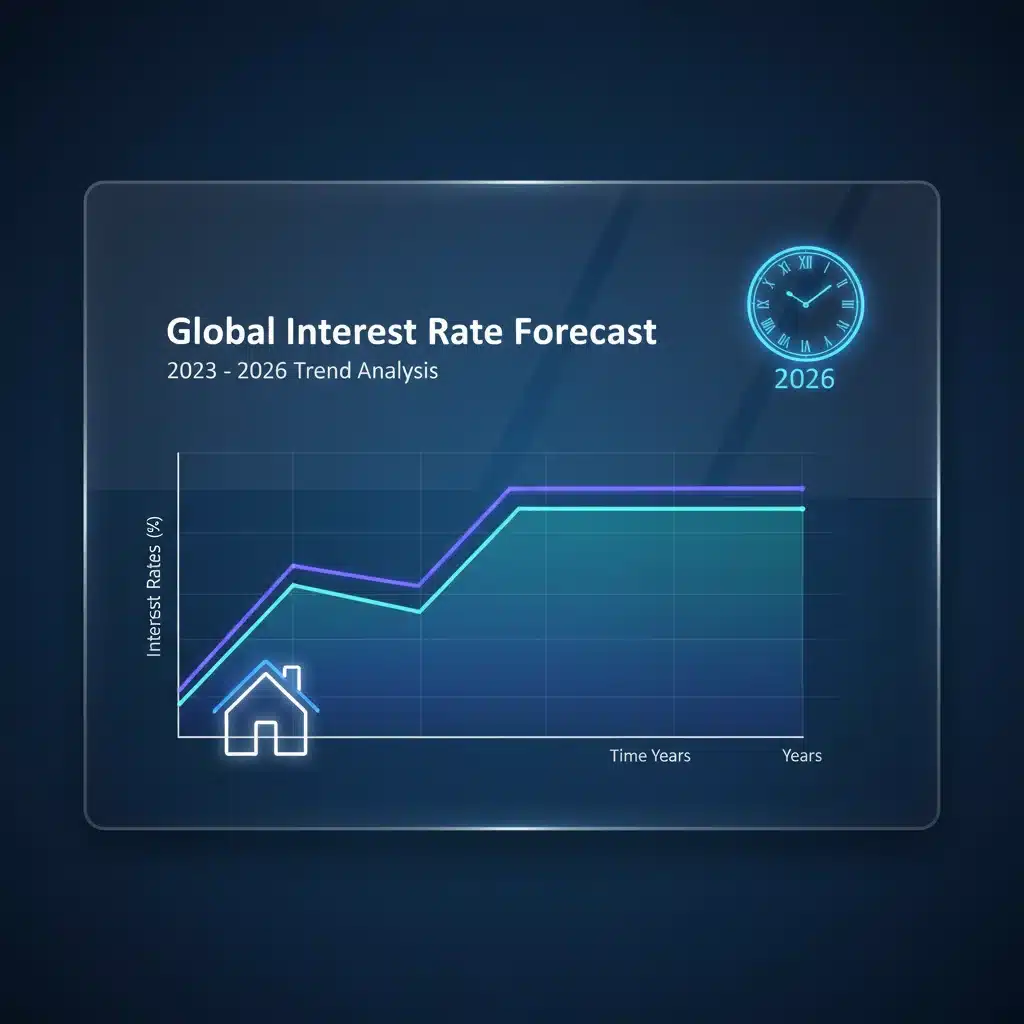
Forecasting interest rates, especially years in advance, is inherently challenging. However, based on current economic trends, Federal Reserve guidance, and historical patterns, we can outline several plausible scenarios for the 2026 interest rate outlook.
Scenario 1: Gradual Normalization
In this scenario, inflation continues its downward trend, gradually approaching the Fed’s 2% target without a significant economic downturn. The labor market remains relatively strong but cools enough to alleviate wage pressures. Under these conditions, the Fed might begin a series of modest rate cuts in late 2024 or 2025, bringing the federal funds rate to a more ‘neutral’ level by 2026. A neutral rate is one that neither stimulates nor restricts economic growth. In this scenario, mortgage rates would likely stabilize at levels somewhat higher than the pre-pandemic era but lower than their recent peaks.
Scenario 2: Persistent Inflation
If inflation proves to be more persistent than anticipated, perhaps due to renewed supply chain disruptions, geopolitical tensions, or stronger-than-expected consumer demand, the Fed might be forced to keep interest rates higher for longer. In this scenario, the federal funds rate could remain elevated through 2025 and into 2026, potentially leading to mortgage rates that continue to put pressure on affordability. This ‘higher for longer’ environment would significantly impact borrowing costs.
Scenario 3: Economic Downturn and Rate Cuts
Conversely, a more severe economic downturn or a recession could prompt the Fed to aggressively cut interest rates to stimulate growth and employment. If the economy significantly weakens, the Fed might prioritize supporting economic activity over fighting inflation, leading to substantial rate reductions by 2026. While lower mortgage rates would be a silver lining for homebuyers, this scenario would come with the broader challenges of a struggling economy.
The ‘Dot Plot’ and Market Expectations
The Fed’s ‘dot plot,’ which represents individual FOMC members’ projections for the federal funds rate, offers a glimpse into their collective thinking about the future. While not a guarantee, it provides valuable insight into the expected path of monetary policy. As of recent projections, many members anticipate a gradual easing of rates, but the exact timing and magnitude remain subject to economic data. The market, through futures contracts, also forms its own expectations, which can sometimes diverge from the Fed’s official guidance.
How a 0.5% Shift in Interest Rates Impacts Your Mortgage
Even a seemingly small 0.5% change in mortgage interest rates can have a substantial impact on your monthly payments and the total cost of your home over the life of the loan. This is a critical consideration for anyone looking at the 2026 interest rate outlook.
Illustrative Example
Let’s consider a hypothetical scenario: a $400,000 30-year fixed-rate mortgage.
- At 6.5% interest: Your estimated monthly principal and interest payment would be approximately $2,528.
- At 7.0% interest (a 0.5% increase): Your estimated monthly principal and interest payment would rise to approximately $2,661.
- At 6.0% interest (a 0.5% decrease): Your estimated monthly principal and interest payment would fall to approximately $2,398.
As you can see, a 0.5% increase translates to an extra $133 per month, or over $47,000 over the 30-year life of the loan. Conversely, a 0.5% decrease saves you $130 per month, or over $46,000 over the loan term. These figures do not even include property taxes or homeowner’s insurance, which would be added to your total monthly housing cost. Such a change can significantly affect your budget and debt-to-income ratio, potentially influencing your ability to qualify for a loan or the size of the home you can afford.
Impact on Affordability and the Housing Market
Higher interest rates reduce purchasing power, as a larger portion of a borrower’s monthly payment goes towards interest. This can cool down a hot housing market by making homes less affordable for prospective buyers. Conversely, lower rates can stimulate demand, potentially driving up home prices. The sensitivity of the housing market to interest rate fluctuations makes the 2026 interest rate outlook a pivotal factor for both buyers and sellers.
Refinancing Opportunities
For existing homeowners, a decrease in interest rates could present an opportunity to refinance their mortgage, securing a lower monthly payment or a shorter loan term. Even a 0.5% drop can make refinancing a worthwhile consideration, depending on closing costs and how long you plan to stay in your home. Monitoring the 2026 interest rate outlook for potential downward trends is therefore essential for current homeowners.
Strategies for Navigating the 2026 Interest Rate Outlook
Given the uncertainties surrounding the 2026 interest rate outlook, proactive financial planning is paramount. Whether you’re a first-time homebuyer, an existing homeowner, or an investor, there are strategies you can employ to mitigate risks and capitalize on opportunities.
For Prospective Homebuyers
- Get Pre-Approved: A pre-approval locks in an interest rate for a certain period, protecting you from potential rate hikes while you search for a home.
- Improve Your Credit Score: A higher credit score can qualify you for the best available interest rates, saving you thousands over the life of the loan.
- Save for a Larger Down Payment: A larger down payment reduces the amount you need to borrow, thereby lessening the impact of higher interest rates on your monthly payments.
- Consider Adjustable-Rate Mortgages (ARMs) with Caution: While ARMs often offer lower initial rates, they come with the risk of rates adjusting upwards. Understand the terms and your risk tolerance.
For Current Homeowners
- Monitor Rates for Refinancing Opportunities: Keep an eye on the 2026 interest rate outlook. If rates decline significantly, refinancing could save you money.
- Pay Extra on Your Principal: Even small additional payments can reduce the total interest paid and shorten the loan term, especially beneficial if rates remain elevated.
- Build an Emergency Fund: A robust emergency fund can provide a buffer against unexpected financial strains, especially if your mortgage payments increase due to an ARM or other unforeseen circumstances.

For Investors and the Broader Economy
The 2026 interest rate outlook also has broader implications. Higher rates can increase the cost of capital for businesses, potentially slowing investment and expansion. This can affect stock market performance, as corporate earnings may be pressured. Investors should consider how different interest rate scenarios might impact their portfolios and adjust their strategies accordingly. Sectors sensitive to interest rates, such as real estate and utilities, might experience more volatility.
The Role of Government Policy Beyond the Fed
While the Federal Reserve is the primary architect of monetary policy, other government policies can also influence the 2026 interest rate outlook and the broader economy. Fiscal policy, enacted by Congress and the President, involves government spending and taxation. Large government deficits, for example, can lead to increased borrowing by the Treasury, which can put upward pressure on interest rates as the government competes with private borrowers for available capital.
Regulatory Environment
Changes in financial regulations can also play a role. Regulations affecting banks’ capital requirements or lending standards can influence the availability and cost of credit. While these are typically not as direct as Fed rate decisions, their cumulative effect can be significant over time. Understanding the interplay between monetary policy, fiscal policy, and regulatory changes provides a more holistic view of the economic forces shaping the future.
Conclusion: Preparing for the 2026 Interest Rate Outlook
The 2026 interest rate outlook is a complex puzzle, influenced by a myriad of economic indicators and the thoughtful, yet often unpredictable, decisions of the Federal Reserve. While precise predictions are impossible, understanding the underlying drivers and potential scenarios empowers individuals and businesses to make informed financial choices. A 0.5% shift in mortgage rates, though seemingly minor, can have a tangible impact on your household budget and long-term financial health. By staying informed about inflation trends, employment data, and the Fed’s forward guidance, you can better position yourself to navigate the evolving economic landscape. Proactive planning, whether it involves improving your credit, saving for a larger down payment, or monitoring refinancing opportunities, remains your best defense and offense in an uncertain interest rate environment. The future of interest rates will continue to be a topic of intense discussion, and your preparedness will be key to financial resilience.