2026 Social Security COLA: What a 3.2% Increase Means for Your Benefits

The financial landscape for retirees and Social Security beneficiaries is constantly evolving, with annual Cost-of-Living Adjustments (COLAs) playing a pivotal role in maintaining purchasing power. As we look ahead, projections for the 2026 Social Security COLA are beginning to surface, with a significant 3.2% increase currently anticipated. This potential adjustment is not just a number; it represents a crucial lifeline for millions of Americans, directly impacting their monthly income and overall financial stability. Understanding what a 3.2% increase means, how it’s determined, and its broader implications is essential for anyone relying on or planning for Social Security benefits.
The Social Security Administration (SSA) implements COLAs to ensure that the value of benefits does not erode due to inflation. Without these adjustments, the fixed income of retirees would steadily lose its buying power, making it increasingly difficult to cover essential expenses like housing, food, and healthcare. The 2026 Social Security COLA, if it lands at 3.2%, would follow a series of recent adjustments that have reflected varying inflationary pressures. This article will delve deep into the mechanics of COLA, analyze the projected 3.2% increase, and provide insights into how beneficiaries can prepare for and maximize the impact of this adjustment.
Understanding the Cost-of-Living Adjustment (COLA)
To fully grasp the significance of the projected 2026 Social Security COLA, it’s important to understand what COLA is and how it’s calculated. COLA is an annual increase in Social Security and Supplemental Security Income (SSI) benefits to offset the effects of inflation. It’s designed to ensure that the purchasing power of benefits remains relatively stable over time.
How COLA is Calculated
The Social Security Administration bases its annual COLA on the Consumer Price Index for Urban Wage Earners and Clerical Workers (CPI-W). Specifically, the average CPI-W for the third quarter (July, August, and September) of the current year is compared to the average CPI-W for the third quarter of the last year in which a COLA was effective. If there’s an increase, the percentage difference, rounded to the nearest one-tenth of one percent, becomes the COLA for the following year. For example, to determine the 2026 Social Security COLA, the SSA will compare the average CPI-W for Q3 2025 to the average CPI-W for Q3 2024. This method ensures that the adjustment reflects recent inflationary trends.
Historical Context of COLA
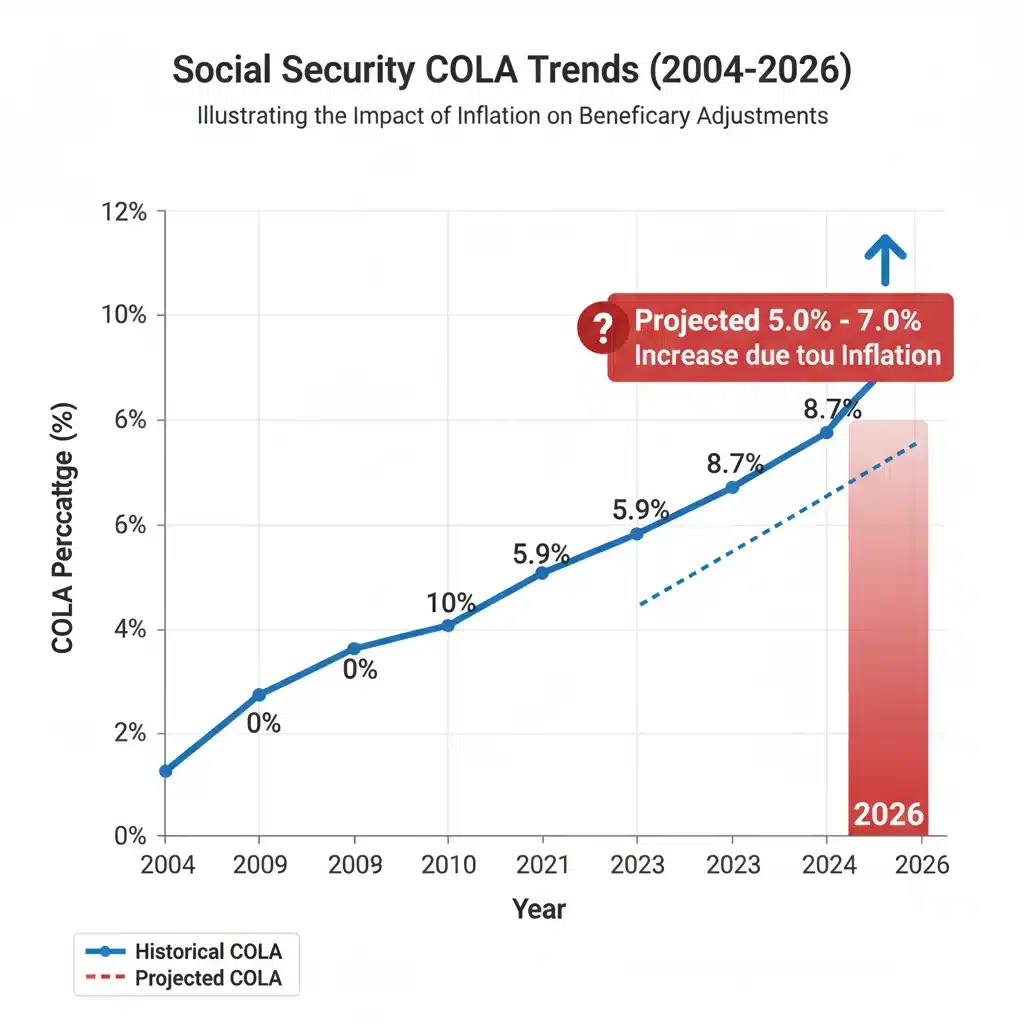
The history of COLA reflects periods of high inflation and more moderate price increases. There have been years with substantial COLAs, particularly during periods of high energy costs and economic volatility, and years with very low or even zero increases when inflation was minimal. These fluctuations highlight the importance of staying informed about economic indicators that influence the CPI-W and, consequently, the 2026 Social Security COLA. Understanding this historical context provides a better framework for anticipating future adjustments and their potential impact on your financial planning.
The Projected 3.2% Increase for 2026
The current projection of a 3.2% increase for the 2026 Social Security COLA is a significant figure that warrants close attention. This projection is based on various economic forecasts, including anticipated inflation rates and consumer spending trends. While it’s important to remember that this is a projection and the final figure will be announced later, it provides a valuable benchmark for financial planning.
What a 3.2% Increase Means in Real Terms
For beneficiaries, a 3.2% increase translates directly into more money in their monthly Social Security checks. To illustrate, if an individual currently receives a monthly benefit of $1,800 (which is close to the average for retired workers), a 3.2% COLA would add approximately $57.60 to their monthly payment, bringing it to $1,857.60. While this might seem like a modest sum to some, for many retirees, especially those on fixed incomes, every additional dollar makes a tangible difference in covering rising costs. This increase helps to maintain the purchasing power of their benefits, allowing them to better afford necessities.
Factors Influencing the 3.2% Projection
Several economic factors contribute to the 3.2% projection for the 2026 Social Security COLA. These typically include:
- Inflationary Pressures: The primary driver of COLA is inflation. If prices for goods and services, particularly those in the CPI-W basket (food, energy, transportation, housing), are expected to rise by approximately 3.2%, then the COLA will reflect that.
- Wage Growth: While not directly tied to COLA calculation, strong wage growth can sometimes correlate with higher consumer demand and thus higher inflation.
- Economic Growth: A robust economy can lead to increased consumer spending and potentially higher prices, indirectly influencing the COLA.
- Global Events: Geopolitical events, supply chain disruptions, and global economic shifts can all impact inflation and, consequently, the COLA.
Analysts consider these and other factors when forecasting the COLA. It’s a complex interplay of economic forces that ultimately determines the final percentage. The 3.2% projection suggests that economists anticipate continued, albeit potentially moderating, inflationary pressures through 2025.
Impact on Different Beneficiary Groups
The 2026 Social Security COLA will affect various beneficiary groups differently, depending on their current benefit levels, other sources of income, and their specific financial situations.
Retirees and Spouses
For the vast majority of retired workers and their spouses, the 3.2% increase will mean a direct boost to their monthly income. This can be particularly impactful for those whose Social Security benefits constitute a significant portion of their retirement income. The additional funds can help cover rising healthcare costs, utility bills, and other essential expenditures, providing a much-needed buffer against inflation. For couples receiving benefits, the combined increase can be even more substantial.
Disabled Workers
Individuals receiving Social Security Disability Insurance (SSDI) benefits will also see their payments increase by 3.2%. This adjustment is crucial for disabled workers, who often face unique financial challenges, including medical expenses and limited earning capacity. The COLA helps ensure that their benefits retain their purchasing power, providing vital support for their living costs.
Survivors
Survivor benefits, paid to widows, widowers, and eligible children of deceased workers, will also be subject to the 3.2% COLA. This adjustment is essential for families who rely on these benefits for their financial well-being, helping them to cope with the ongoing costs of living. For many, survivor benefits are a critical component of their financial safety net.
Potential Medicare Premium Increases
One important consideration for all beneficiaries is the potential impact of Medicare Part B premium increases. Historically, a portion of the COLA can be offset by rising Medicare premiums, which are often deducted directly from Social Security checks. While the ‘hold harmless’ provision protects most beneficiaries from a reduction in their net Social Security benefit due to Medicare premium increases, those new to Medicare or those with higher incomes may still see a significant portion of their COLA absorbed by these costs. It’s crucial for beneficiaries to monitor announcements regarding both COLA and Medicare premiums to understand their net benefit increase.
Planning for the 2026 Social Security COLA
While the 2026 Social Security COLA provides a welcome boost, proactive financial planning is key to maximizing its benefits and ensuring long-term financial security.
Budgeting and Expense Management
With an anticipated 3.2% increase, beneficiaries should revisit their budgets to account for the higher income. This is an opportune time to assess current expenses, identify areas for potential savings, and allocate the additional funds strategically. Consider dedicating a portion of the increase to a savings account, an emergency fund, or to paying down high-interest debt. Even a small increase can make a difference when managed thoughtfully.
Reviewing Other Income Sources
For those with multiple income streams in retirement, such as pensions, 401(k) withdrawals, or investment income, it’s important to consider how the COLA interacts with these other sources. A higher Social Security benefit might impact tax liability, especially if it pushes an individual into a higher income bracket, making a larger portion of their Social Security benefits taxable. Consult with a financial advisor to understand the full tax implications of the increased benefit.
Long-Term Financial Projections
The 2026 Social Security COLA is just one piece of the retirement puzzle. For those still planning for retirement, understanding how COLAs work and anticipating future adjustments can inform long-term financial projections. It reinforces the importance of not relying solely on Social Security and building a diversified retirement portfolio. Future COLAs will continue to be influenced by inflation, so incorporating realistic inflation rates into your financial models is crucial.
The Broader Economic Context and Future Outlook
The projected 2026 Social Security COLA of 3.2% doesn’t exist in a vacuum; it’s a reflection of the broader economic environment. Understanding this context can provide valuable insights into what beneficiaries might expect in the years to come.
Inflation Trends and Economic Stability
The primary driver of COLA is inflation, as measured by the CPI-W. The 3.2% projection suggests that economists anticipate a continued, albeit potentially moderating, inflationary environment through 2025. Factors such as global supply chains, energy prices, housing costs, and consumer demand will all play a role in determining actual inflation rates. A stable economic environment with controlled inflation is generally beneficial for retirees, as it helps to preserve the purchasing power of their fixed incomes.
Impact of Federal Reserve Policies
The Federal Reserve’s monetary policies, particularly interest rate adjustments, have a significant impact on inflation. Efforts by the Fed to control inflation can influence the CPI-W and, consequently, future COLAs. While the Fed’s actions are aimed at broader economic stability, their indirect effects on consumer prices are directly relevant to Social Security beneficiaries. Watching the Fed’s stance on inflation will provide clues about potential future COLA adjustments beyond 2026.
The Future of Social Security Funding
While COLAs address the purchasing power of benefits, the long-term solvency of the Social Security system is a separate but related concern. Discussions about the future of Social Security often involve potential adjustments to benefit formulas, taxation, and eligibility requirements. While these are separate from the annual COLA calculation, beneficiaries should remain aware of ongoing debates and potential legislative changes that could impact their benefits in the longer term. The 2026 Social Security COLA is a short-term adjustment, but the system’s overall health requires continuous monitoring.

Maximizing Your Social Security Benefits
Beyond the annual COLA, there are several strategies beneficiaries and future retirees can employ to maximize their Social Security benefits.
Strategic Claiming Age
One of the most significant decisions is when to claim Social Security benefits. While you can claim as early as age 62, benefits are permanently reduced. Waiting until your Full Retirement Age (FRA) allows you to receive 100% of your earned benefit. For every year you delay claiming past your FRA, up to age 70, your benefits increase by 8% per year, plus any COLAs. This delayed retirement credit can significantly boost your monthly income, and that higher base amount will then be subject to future COLAs, including the 2026 Social Security COLA.
Understanding Spousal and Survivor Benefits
Spousal and survivor benefits can be complex but offer significant financial protection. If you are married, divorced, or widowed, understanding the rules for these benefits can help you claim the maximum amount you are entitled to. For example, a spouse may be eligible for up to 50% of their partner’s full retirement age benefit, and a widow or widower may receive up to 100% of their deceased spouse’s benefit. These benefits are also subject to COLAs, meaning they will increase with the 2026 Social Security COLA.
Working in Retirement
For some beneficiaries, working part-time in retirement can be a way to supplement their income. However, it’s important to be aware of the Social Security earnings limit if you are under your Full Retirement Age. Exceeding this limit can temporarily reduce your benefits. Once you reach your FRA, the earnings limit no longer applies, and you can earn as much as you want without affecting your Social Security payments. Any earnings can also potentially increase your future benefits if your current earnings are higher than those in your past working years.
Staying Informed
The Social Security Administration regularly updates its website with information on COLAs, benefit calculators, and other important resources. Staying informed about changes in policy, economic forecasts, and the annual COLA announcement is crucial for effective financial planning. Regularly reviewing your Social Security statement, which you can access online, provides a personalized estimate of your benefits and earnings record, helping you to plan for the future, taking into account adjustments like the 2026 Social Security COLA.
Conclusion
The projected 3.2% increase for the 2026 Social Security COLA is a critical development for millions of Americans. It underscores the ongoing commitment to ensuring that Social Security benefits maintain their purchasing power in the face of inflation. While this adjustment offers a welcome boost to monthly income, it also serves as a reminder of the importance of comprehensive financial planning. Beneficiaries should use this information to revisit their budgets, understand the broader economic context, and consider strategies to maximize their overall financial well-being.
As the official announcement approaches, staying informed through reliable sources like the Social Security Administration will be paramount. The COLA is more than just a percentage; it’s a reflection of economic realities and a vital component of the financial security of retirees, disabled workers, and survivors across the nation. By understanding its implications and planning accordingly, individuals can better navigate their financial futures and ensure that their Social Security benefits continue to provide the support they need.