Estate Planning 2026: Navigating the $13.61 Million Federal Estate Tax Exemption

Estate Planning 2026: Navigating the $13.61 Million Federal Estate Tax Exemption
As we look ahead to 2026, the landscape of estate planning continues to evolve, presenting both opportunities and challenges for individuals and families aiming to preserve and transfer their wealth. A critical component of this evolving landscape is the federal estate tax exemption, which is projected to reach an impressive $13.61 million per individual. This significant figure, a result of inflation adjustments, offers substantial relief for many high-net-worth individuals, allowing a considerable portion of their estate to pass to heirs free of federal estate tax. However, understanding the nuances of this exemption and proactively engaging in strategic Estate Planning 2026 is more crucial than ever. This comprehensive guide will delve into what the $13.61 million exemption means for you, explore effective strategies to maximize its benefits, and highlight key considerations for a robust estate plan.
The federal estate tax, often referred to as the ‘death tax,’ is a tax on your right to transfer property at your death. It applies to the value of your estate that exceeds the exemption amount. While this tax affects a relatively small percentage of the population, those it does impact face potentially significant liabilities. The current exemption amount is a temporary measure, set to revert to a much lower figure (approximately half, adjusted for inflation) at the end of 2025 unless Congress acts. This impending change makes Estate Planning 2026 a timely and urgent discussion for anyone with substantial assets.
Navigating the complexities of estate tax laws requires careful foresight and expert guidance. This article will serve as your essential resource, breaking down the intricacies of the 2026 exemption, outlining proactive steps you can take today, and emphasizing the importance of working with experienced professionals to tailor a plan that aligns with your unique financial goals and family legacy.
Understanding the Federal Estate Tax Exemption for 2026
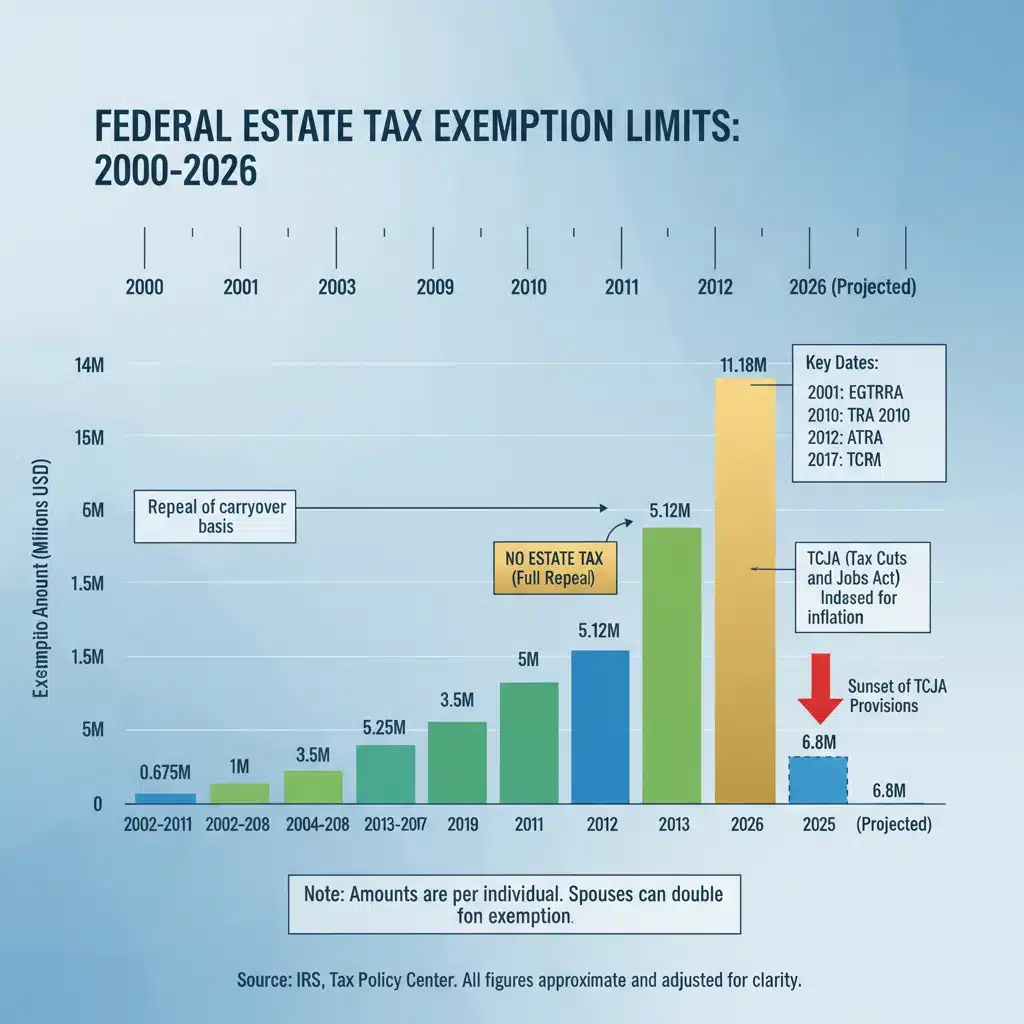
The federal estate tax exemption is the amount of an individual’s estate that can be passed to heirs without incurring federal estate tax. For 2026, this amount is projected to be $13.61 million per individual, or $27.22 million for a married couple, assuming both spouses fully utilize their exemptions. This figure is a projection based on current inflation adjustments and the provisions of the Tax Cuts and Jobs Act (TCJA) of 2017.
The TCJA significantly increased the estate tax exemption, effectively doubling it from its pre-2018 levels. However, this increase is not permanent. A crucial ‘sunset provision’ dictates that, absent new legislation, the exemption amount will revert to its pre-TCJA level (adjusted for inflation) on January 1, 2026. This means the exemption could drop to approximately $7 million per individual in 2026. While our focus here is on the $13.61 million projection, it is vital to acknowledge the uncertainty and the potential for a significant reduction, underscoring the urgency of strategic Estate Planning 2026.
For those whose estates are likely to exceed the exemption amount, understanding the implications is paramount. The federal estate tax rate for amounts above the exemption is currently 40%. This substantial rate can significantly erode the value of an inheritance if not properly addressed through proactive planning. State estate taxes and inheritance taxes also add another layer of complexity, as many states have their own thresholds and rates, which may be much lower than the federal exemption.
The concept of ‘portability’ is also a cornerstone of modern estate planning for married couples. Portability allows the surviving spouse to use any unused portion of the deceased spouse’s federal estate tax exemption. This means that if one spouse dies without fully utilizing their $13.61 million exemption, the remaining amount can be added to the surviving spouse’s exemption, potentially allowing a married couple to pass $27.22 million tax-free. However, portability is not automatic; it requires the timely filing of an estate tax return (Form 706) by the executor of the deceased spouse’s estate, even if no tax is due. This is a critical step that many estates overlook, leading to missed opportunities.
Key Strategies for Effective Estate Planning in 2026
With the federal estate tax exemption at $13.61 million, many high-net-worth individuals have an unprecedented opportunity to transfer significant wealth tax-free. However, given the potential sunset of the TCJA provisions, acting strategically and promptly is essential. Here are some key strategies to consider for your Estate Planning 2026:
1. Gifting Strategies: Maximize Annual and Lifetime Exclusions
One of the most powerful tools in estate planning is gifting. Gifts made during your lifetime can reduce the size of your taxable estate. The annual gift tax exclusion allows you to give a certain amount to as many individuals as you wish each year, free of gift tax, without using any of your lifetime exemption. For 2026, this amount is expected to be around $18,000 per donee. A married couple can ‘split’ gifts, effectively giving $36,000 per donee annually.
Beyond the annual exclusion, you can also make larger gifts that utilize a portion of your lifetime gift tax exemption, which is unified with the estate tax exemption. This means that any amount you gift above the annual exclusion reduces your $13.61 million lifetime exemption. The benefit of making large gifts now, while the exemption is high, is that the appreciation on those gifted assets is removed from your estate. If the exemption amount does indeed revert in 2026, gifts made before the sunset date will lock in the higher exemption amount. This ‘use it or lose it’ mentality is driving many individuals to accelerate their gifting plans.
Consider gifts to irrevocable trusts, such as Spousal Lifetime Access Trusts (SLATs) or Grantor Retained Annuity Trusts (GRATs), which can remove assets and their future appreciation from your estate while potentially providing some control or benefits to beneficiaries. These sophisticated trusts require careful legal and tax advice.
2. Review and Update Your Will and Trusts
Your will is the cornerstone of your estate plan, dictating how your assets will be distributed upon your death. Trusts, on the other hand, can offer greater control, privacy, and tax efficiency, especially for larger estates. Both should be reviewed regularly, but especially in anticipation of significant changes to tax laws.
Ensure your will accurately reflects your current wishes regarding beneficiaries, guardians for minor children, and the executor of your estate. For trusts, consider if they are still aligned with your objectives and if they are structured to take full advantage of the current exemption levels. For example, some older trusts might contain formulas based on lower exemption amounts that need updating to maximize the $13.61 million. Similarly, if you have established irrevocable trusts, review their terms to ensure they continue to meet your long-term goals and adapt to any legislative changes.
It’s also important to consider the impact of state estate taxes. Even if your estate falls below the federal exemption, it might still be subject to state-level taxes. Your will and trust documents can be drafted to minimize these state tax liabilities where applicable.
3. Optimize Beneficiary Designations
Many assets, such as retirement accounts (IRAs, 401(k)s), life insurance policies, and annuities, pass directly to designated beneficiaries outside of your will and, in some cases, outside of your probate estate. It is critical to review these beneficiary designations regularly to ensure they align with your overall estate plan and current wishes.
Outdated beneficiary designations can inadvertently lead to unintended heirs, significant tax consequences, or delays in asset distribution. For example, if your primary beneficiary has passed away and you haven’t updated the designation, the assets might go to your contingent beneficiary or, worse, through probate. For retirement accounts, naming a spouse, a trust, or a charity as a beneficiary can have different tax implications, so professional advice is essential to optimize these designations for tax efficiency and your desired legacy.
4. Consider Advanced Estate Planning Techniques
For individuals with estates significantly above the exemption amount, or those looking for more sophisticated ways to transfer wealth, several advanced techniques can be employed:
- Irrevocable Life Insurance Trusts (ILITs): An ILIT can hold a life insurance policy, removing the death benefit from your taxable estate. This can provide liquidity to pay estate taxes or distribute wealth to heirs tax-free.
- Grantor Retained Annuity Trusts (GRATs): A GRAT allows you to transfer appreciating assets into a trust while retaining an annuity payment for a set term. If the assets appreciate more than the IRS-mandated interest rate, the excess passes to your beneficiaries free of gift and estate tax.
- Charitable Planning: Techniques like Charitable Remainder Trusts (CRTs) or Charitable Lead Trusts (CLTs) can provide income streams, reduce estate taxes, and fulfill philanthropic goals.
- Family Limited Partnerships (FLPs) and Limited Liability Companies (LLCs): These entities can be used to hold family assets, provide for orderly succession, and potentially allow for valuation discounts for gift and estate tax purposes.
These strategies are complex and require careful consideration of your specific circumstances, risk tolerance, and long-term objectives. Consulting with an experienced estate planning attorney and financial advisor is crucial before implementing any advanced techniques.
5. Plan for Liquidity
Even if your estate falls within the federal exemption, or if you’ve minimized your federal estate tax liability, your estate might still face other expenses, such as state estate taxes, administration costs, and outstanding debts. Ensuring your estate has sufficient liquidity (cash or easily convertible assets) is vital to avoid forced sales of illiquid assets (like real estate or a family business) at unfavorable prices.
Life insurance is a common tool used to provide liquidity for estate expenses. Other strategies include establishing cash reserves, holding diversified investment portfolios, or planning for the sale of certain assets. A lack of liquidity can cause significant distress for your heirs and complicate the estate administration process.
The Impact of Potential Legislative Changes on Estate Planning 2026
The most significant factor influencing Estate Planning 2026 is the sunset provision of the TCJA. As mentioned, without congressional action, the federal estate tax exemption is scheduled to revert to approximately $7 million per individual (adjusted for inflation) on January 1, 2026. This potential decrease would dramatically alter the landscape for many high-net-worth individuals, bringing a larger number of estates into the realm of federal estate taxation.
While political predictions are inherently uncertain, the possibility of a reduced exemption necessitates proactive planning. Many advisors are recommending that clients with estates approaching or exceeding the projected $7 million mark consider utilizing the higher exemption amounts available now through gifting strategies. The IRS has provided guidance confirming that gifts made under the higher exemption amounts will not be ‘clawed back’ if the exemption later decreases. This offers a strong incentive to act sooner rather than later.
Beyond the sunset provision, other legislative changes could also impact estate planning. There is ongoing discussion in Washington regarding potential reforms to capital gains taxes, step-up in basis rules, and the taxation of trusts. While these are speculative, staying informed about legislative developments and maintaining flexibility in your estate plan is prudent.

The Role of Professional Advisors in Estate Planning 2026
Effective estate planning is rarely a do-it-yourself endeavor. The complexities of tax law, property law, and family dynamics require the expertise of a team of professional advisors. For Estate Planning 2026, this team typically includes:
- Estate Planning Attorney: An attorney specializes in drafting wills, trusts, powers of attorney, and other legal documents necessary to implement your plan. They ensure your plan complies with all relevant laws and accurately reflects your wishes.
- Financial Advisor: A financial advisor helps you assess your current assets, project future growth, and integrate your estate plan with your overall financial strategy. They can advise on investment strategies that support your estate planning goals.
- Tax Advisor/CPA: A tax professional provides guidance on the income, gift, and estate tax implications of your planning decisions, helping to minimize tax liabilities and ensure compliance.
- Insurance Professional: An insurance agent can help you determine if life insurance or other insurance products are appropriate for providing liquidity, protecting assets, or funding specific legacies.
These professionals work collaboratively to create a holistic estate plan that addresses all facets of your financial life and personal wishes. Regular meetings with your advisory team are essential to review and update your plan as your circumstances change or as new legislation is enacted.
Common Misconceptions in Estate Planning
Despite its importance, estate planning is often surrounded by misconceptions that can lead to costly errors. Addressing these can significantly improve your approach to Estate Planning 2026:
- "I’m not wealthy enough for estate planning." While the federal estate tax primarily affects high-net-worth individuals, estate planning is crucial for everyone. A basic will, power of attorney, and healthcare directives ensure your wishes are honored, regardless of your net worth.
- "A will is all I need." A will is essential, but it only covers assets that pass through probate. Many assets pass via beneficiary designation or joint ownership. Furthermore, a will does not avoid probate, which can be a lengthy and public process. Trusts can often provide more comprehensive solutions.
- "My family knows what I want." Verbal wishes are rarely legally binding and can lead to disputes among heirs. Clear, legally documented instructions are vital to ensure your legacy is distributed as intended.
- "Estate planning is a one-time event." Estate planning is an ongoing process. Life events (marriage, divorce, births, deaths, changes in wealth) and legislative changes necessitate regular reviews and updates to your plan.
- "Gifting is always the best option." While gifting can reduce your taxable estate, it also means relinquishing control over the assets. There are also potential income tax implications, such as the loss of a step-up in basis for the recipient if the assets are highly appreciated.
Dispelling these myths is the first step toward creating a truly effective and resilient estate plan that serves your long-term interests and protects your beneficiaries.
Steps to Take Now for Estate Planning 2026
Given the projected federal estate tax exemption of $13.61 million and the looming sunset of the TCJA provisions, taking proactive steps now is more important than ever. Here’s a checklist to guide your immediate actions for robust Estate Planning 2026:
- Inventory Your Assets: Compile a comprehensive list of all your assets, including real estate, investments, retirement accounts, life insurance policies, business interests, and personal property. Document their estimated values and how they are titled.
- Review Your Current Estate Plan: Gather all existing estate planning documents (wills, trusts, powers of attorney, advance directives). Understand what they say and how they align with your current wishes.
- Identify Your Goals: Clearly define your objectives for your estate. Do you want to minimize taxes, provide for specific heirs, support charities, or ensure the continuity of a family business?
- Consult with Your Advisory Team: Schedule meetings with your estate planning attorney, financial advisor, and tax professional. Discuss the implications of the $13.61 million exemption and the potential sunset of the TCJA.
- Consider Gifting Strategies: Explore opportunities to make annual exclusion gifts or utilize a portion of your lifetime exemption through larger gifts, especially if you anticipate the exemption decreasing in 2026.
- Update Beneficiary Designations: Verify that all beneficiary designations on your retirement accounts, life insurance policies, and other assets are current and align with your overall plan.
- Plan for Potential Changes: Discuss with your advisors how your estate plan would be affected by a reduced exemption amount and what contingency plans should be in place.
- Educate Your Family: While details don’t need to be public, ensure key family members or trusted individuals understand where important documents are located and who your advisors are.
By taking these steps, you can position yourself to effectively navigate the complexities of estate planning in 2026 and beyond, ensuring your legacy is protected and your wishes are honored.
Conclusion: Securing Your Legacy in a Changing Tax Environment
The projected federal estate tax exemption of $13.61 million per individual for 2026 offers an extraordinary opportunity for wealth transfer. However, the temporary nature of this high exemption, coupled with the potential for legislative changes, underscores the critical need for proactive and sophisticated Estate Planning 2026. This is not a time for complacency but for strategic action.
Whether your estate is substantial or more modest, a well-crafted estate plan provides peace of mind, ensures your assets are distributed according to your wishes, minimizes tax burdens, and avoids potential family disputes. By understanding the current tax landscape, exploring various planning strategies, and collaborating with a dedicated team of professional advisors, you can confidently navigate the future of estate planning and secure your legacy for generations to come.
Don’t wait until it’s too late. The time to plan for 2026 is now. Engage with experts, review your current situation, and make informed decisions that will protect your family and your wealth against an uncertain future.