Micro-Credentials vs. Traditional Degrees: A 2026 US Job Market Analysis
The landscape of education and employment is undergoing a profound transformation. As we look towards 2026, the traditional four-year degree, long considered the gold standard for career entry and advancement, is increasingly being challenged by the rise of micro-credentials job market relevance. This shift isn’t just a fleeting trend; it’s a fundamental re-evaluation of what constitutes valuable skills and how they are acquired and recognized in a rapidly evolving economy.
For decades, a college degree was the undisputed gateway to professional success in the United States. It signified not only a broad knowledge base but also critical thinking, perseverance, and a foundational understanding of various disciplines. However, the accelerating pace of technological change, coupled with the increasing cost of higher education and the demand for highly specialized skills, has opened the door for alternative educational pathways.
Micro-credentials, often shorter, more focused programs that validate specific skills or competencies, are gaining significant traction. They promise agility, affordability, and direct applicability to current job market needs. But do they truly offer a viable alternative or complement to traditional degrees? And what does this mean for job seekers, employers, and educational institutions in the US by 2026?
This comprehensive analysis delves into the intricate dynamics of the micro-credentials job market versus the enduring value of traditional degrees. We will explore the driving forces behind this educational paradigm shift, examine the benefits and drawbacks of each pathway, and provide an insightful forecast for how these credentials will shape career opportunities and talent acquisition strategies in the coming years.
The Evolving Educational Landscape: Why the Shift?
Several critical factors are fueling the growing prominence of micro-credentials and prompting a re-evaluation of traditional higher education. Understanding these drivers is key to grasping the future of the micro-credentials job market.
Technological Disruption and Skill Obsolescence
The most significant catalyst is undoubtedly rapid technological advancement. Industries are being reshaped at an unprecedented pace, leading to a constant demand for new, specialized skills. What was cutting-edge five years ago might be outdated today. Traditional degree programs, by their nature, often struggle to keep up with this speed. Their curricula are typically developed over longer cycles, making them less responsive to immediate industry needs.
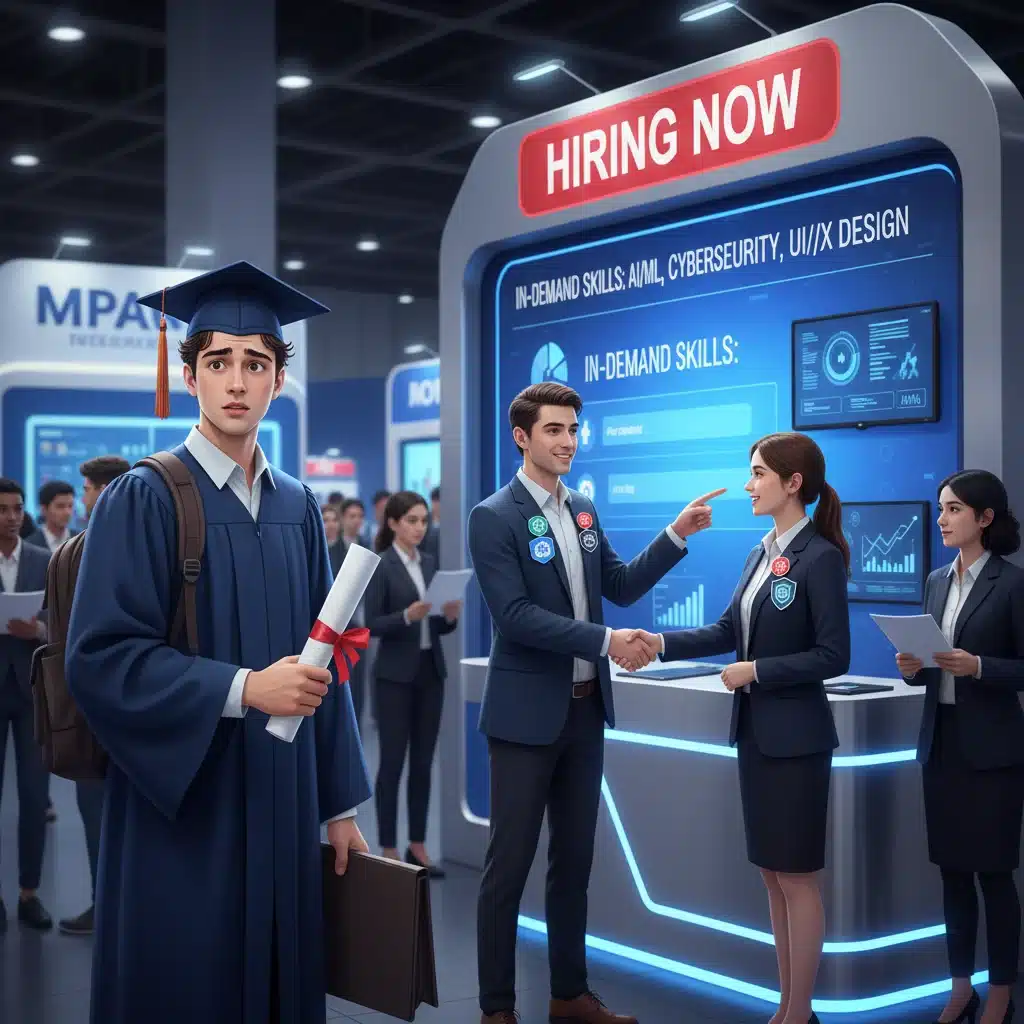
Micro-credentials, on the other hand, are designed for agility. They can be developed and updated quickly to address emerging skill gaps, offering targeted training in areas like artificial intelligence, cybersecurity, cloud computing, data science, and digital marketing. This responsiveness makes them incredibly attractive to both individuals seeking to upskill or reskill and employers looking for specific expertise.
The Rising Cost of Traditional Higher Education
The escalating cost of a four-year degree in the US is another major factor. Student loan debt has reached staggering levels, causing many to question the return on investment of a traditional degree, especially if it doesn’t directly lead to a high-paying job. Micro-credentials often present a more affordable entry point into specialized fields, allowing individuals to gain valuable skills without incurring massive debt.
For many, the idea of paying tens or even hundreds of thousands of dollars for a degree that might not guarantee employment in their desired field is becoming less appealing. The micro-credentials job market offers a more economical and time-efficient alternative for acquiring in-demand competencies.
Demand for Specialized Skills and Just-in-Time Learning
Employers increasingly prioritize specific, demonstrable skills over broad academic knowledge. While a traditional degree provides a strong foundation, many roles now require deep expertise in particular tools, platforms, or methodologies. The ‘just-in-time’ learning model, where individuals acquire skills precisely when they need them for a specific job or project, aligns perfectly with the micro-credential philosophy.
Companies are less willing to invest heavily in training new hires on fundamental skills that could have been acquired through more focused, shorter programs. They seek candidates who can hit the ground running, possessing the exact capabilities required for the role. This trend significantly boosts the value of the micro-credentials job market.
Understanding Micro-Credentials: What Are They?
Before diving deeper into their impact, it’s crucial to define what micro-credentials entail. They are typically short, focused, competency-based certifications that validate specific skills or knowledge areas. They can take various forms, including:
- Badges: Digital representations of achievements, often issued by platforms like Credly or Open Badges.
- Certificates: Formal recognition of completing a short course or program, often offered by universities, bootcamps, or industry leaders.
- Nanodegrees: Programs offered by platforms like Udacity, designed to teach specific in-demand skills in a relatively short timeframe.
- Professional Certifications: Industry-recognized certifications (e.g., AWS Certified Solutions Architect, Google Project Management Certificate).
The key characteristics of micro-credentials are their brevity, focus, and direct relevance to workplace skills. They are often stackable, meaning individuals can combine several micro-credentials to build a comprehensive skill set or even work towards a larger qualification. This modularity is a significant advantage in the dynamic micro-credentials job market.

The Enduring Value of Traditional Degrees
Despite the rise of micro-credentials, it would be a mistake to dismiss the traditional degree as obsolete. Universities and colleges continue to play a vital role in education and workforce development, offering unique benefits that micro-credentials often cannot replicate.
Broad Foundational Knowledge and Critical Thinking
Traditional degrees, particularly liberal arts and sciences programs, provide a broad foundational education. They expose students to diverse subjects, foster critical thinking, problem-solving abilities, communication skills, and a deeper understanding of complex issues. These ‘soft skills’ or ‘power skills’ are increasingly recognized as essential for long-term career success and adaptability.
While micro-credentials excel at imparting specific technical skills, they often don’t provide the same breadth of knowledge or the rigorous training in analytical and conceptual thinking that a comprehensive university education offers. Many employers still value these foundational skills, especially for leadership roles or positions requiring adaptability across various domains.
Networking Opportunities and Personal Development
University environments offer unparalleled networking opportunities with peers, professors, and alumni. These connections can be invaluable for career advancement, mentorship, and future collaborations. Beyond academics, the college experience often fosters significant personal growth, independence, and the development of social skills through extracurricular activities and communal living.
While some micro-credential programs offer online communities, they typically don’t provide the same immersive social and professional development environment as a traditional campus. This aspect of personal and professional networking remains a strong advantage for those pursuing a traditional degree.
Gateway to Certain Professions and Graduate Studies
For many professions, a traditional bachelor’s degree remains a non-negotiable entry requirement. Fields like medicine, law, engineering, and certain scientific research roles almost universally demand a four-year degree, often as a prerequisite for further graduate studies or licensure. The micro-credentials job market, while growing, has not yet fully penetrated these highly regulated or knowledge-intensive sectors.
Furthermore, a traditional degree is typically a prerequisite for pursuing master’s or doctoral degrees, which are essential for academic careers, advanced research, and specialized professional roles. For individuals with these aspirations, the traditional degree path remains indispensable.
Micro-Credentials vs. Traditional Degrees: A 2026 Outlook
By 2026, the US job market will likely see a more integrated and nuanced approach to credentialing. It won’t be a matter of one completely replacing the other, but rather a recognition of their distinct strengths and synergistic potential.
For Job Seekers: Strategic Stacking and Lifelong Learning
For job seekers, the future will emphasize strategic credential stacking. A traditional degree might provide the foundational knowledge and broad skills, while micro-credentials will offer the specialized, in-demand technical expertise. For example, a marketing graduate might pursue micro-credentials in specific digital advertising platforms or SEO tools to enhance their employability.
Lifelong learning will no longer be a buzzword but a necessity. The shelf-life of skills is shrinking, meaning professionals will need to continuously update their knowledge through micro-credentials to remain competitive in the micro-credentials job market. This approach allows individuals to adapt quickly to new technologies and industry demands without committing to another multi-year degree program.
For Employers: Skills-Based Hiring and Hybrid Talent
Employers will increasingly adopt skills-based hiring practices, prioritizing demonstrable competencies over traditional pedigree alone. While a degree might still be a filter for some roles, hiring managers will pay closer attention to the specific skills validated by micro-credentials. This shift will broaden the talent pool, allowing companies to tap into a more diverse range of candidates who may have taken non-traditional educational paths.
The ideal candidate in 2026 might be a ‘hybrid talent’ – someone with a strong foundational education (possibly a traditional degree) augmented by a portfolio of relevant micro-credentials. Companies will value individuals who can demonstrate both broad understanding and deep, current expertise in specific areas crucial to their business. This will fundamentally reshape how employers navigate the micro-credentials job market.
For Educational Institutions: Blended Models and New Offerings
Universities and colleges are already adapting. Many are beginning to offer their own micro-credentials, short courses, and executive education programs. This allows them to stay relevant, cater to a broader student demographic, and provide pathways for alumni to reskill or upskill. We will see more blended models, where traditional degrees might incorporate micro-credential components or where universities partner with industry to co-create specialized certifications.
The traditional institutions that thrive will be those that embrace flexibility, responsiveness, and a focus on measurable learning outcomes, effectively integrating into the burgeoning micro-credentials job market while maintaining the integrity of their degree programs.
Key Industries and the Micro-Credentials Impact in 2026
Certain industries are particularly ripe for disruption and transformation by the micro-credentials job market. Understanding these sectors provides a clearer picture of where this trend will have the most significant impact.
Technology and IT
This sector is arguably where micro-credentials have already made the deepest inroads. The rapid evolution of software, hardware, and cybersecurity threats necessitates continuous learning. Certifications from major tech companies (e.g., Microsoft, Google, Amazon Web Services, Cisco) are often more valuable to employers than a generic computer science degree alone for specific roles. By 2026, proficiency in AI/ML, blockchain, quantum computing fundamentals, and advanced cybersecurity will largely be validated through micro-credentials.
Healthcare and Biotech
While core medical and research roles will still heavily rely on traditional degrees, the healthcare sector is increasingly adopting technology and requiring specialized skills in areas like health informatics, telemedicine platforms, medical coding, and digital health records management. Micro-credentials can quickly train professionals to use new medical devices, software, or comply with evolving regulations, making them crucial for career agility in this field.
Advanced Manufacturing and Engineering
The rise of Industry 4.0, automation, and robotics demands new skills in areas such as industrial IoT, additive manufacturing (3D printing), data analytics for production optimization, and advanced robotics programming. Engineers and technicians will increasingly need micro-credentials to stay current with these rapidly advancing technologies and contribute effectively to modern manufacturing processes.
Marketing and Digital Media
The digital marketing landscape changes almost daily. Skills in SEO, SEM, social media marketing, content strategy, data analytics for marketing, and specific platform expertise (e.g., HubSpot, Salesforce Marketing Cloud) are highly sought after. Micro-credentials from platforms like Google Ads, Facebook Blueprint, or specialized digital marketing academies will be essential for professionals to demonstrate their current capabilities and remain competitive.
Business and Data Analytics
Across almost all industries, the ability to collect, analyze, and interpret data is paramount. Micro-credentials in data visualization, statistical software (e.g., R, Python), business intelligence tools (e.g., Tableau, Power BI), and specific analytical methodologies will be highly prized. These focused credentials allow individuals to quickly gain the skills needed to transform raw data into actionable insights, driving business decisions.
Challenges and Considerations for the Future
While the micro-credentials job market offers numerous advantages, there are challenges and considerations that need to be addressed for its full potential to be realized by 2026.
Quality Control and Standardization
One of the main concerns is the lack of universal quality control and standardization across the vast array of micro-credentials. How do employers differentiate between a high-quality, rigorous program and a less credible one? Accreditation bodies and industry associations will need to play a more significant role in establishing standards and vetting providers to ensure the value of these credentials.
Employer Recognition and Understanding
While recognition is growing, not all employers fully understand or value micro-credentials equally. There’s a need for continued education and advocacy to help HR departments and hiring managers integrate these new forms of validation into their recruitment processes. Clear communication about the skills validated by micro-credentials will be crucial.
Accessibility and Equity
While often more affordable than traditional degrees, access to high-quality micro-credentials can still be an issue for underserved populations. Ensuring equitable access to these learning opportunities, potentially through scholarships, public funding, or employer-sponsored programs, will be vital to leveraging their potential for workforce development across all demographics.
Integration with Traditional Pathways
The future likely involves a more seamless integration between micro-credentials and traditional degrees. This could mean universities offering credit for certain micro-credentials, or employers recognizing a combination of both as a valid pathway to employment and advancement. Creating clear pathways for stacking credentials will be essential for career progression.
Conclusion: A Hybrid Future for the US Job Market
By 2026, the US job market will have moved beyond a simple ‘either/or’ debate between micro-credentials and traditional degrees. Instead, it will embrace a more dynamic and hybrid ecosystem where both play crucial, complementary roles. Traditional degrees will continue to provide foundational knowledge, critical thinking, and a broad understanding essential for complex problem-solving and leadership.
Concurrently, the micro-credentials job market will flourish, offering rapid, targeted skill acquisition that directly addresses the immediate and evolving needs of industries. Professionals will leverage micro-credentials for upskilling, reskilling, and demonstrating specialized expertise, making lifelong learning a continuous journey rather than a one-time event.
Employers will increasingly value a holistic view of a candidate’s capabilities, considering a combination of academic background, practical experience, and a portfolio of relevant micro-credentials. Educational institutions will adapt by offering more flexible, modular learning options that cater to diverse student needs and career goals.
For individuals navigating this evolving landscape, the key will be strategic planning. Understand your career goals, identify the essential skills required, and then choose the most effective and efficient pathways to acquire and validate those skills, whether through a traditional degree, a micro-credential, or, most likely, a smart combination of both. The future of work in the US is flexible, skill-centric, and continuously learning.