Optimize 529 Plans: Save Up to $5,000 Annually for 2026 Education Costs

Optimizing 529 plans in 2026 offers American families a crucial opportunity to significantly reduce education expenses, potentially saving up to $5,000 annually through strategic contributions and tax-advantaged growth for various qualified costs.
As education costs continue their upward trajectory, understanding how to effectively optimize 529 plans becomes not just beneficial, but essential for families aiming to provide quality education without crippling debt. With the year 2026 on the horizon, proactive planning and strategic utilization of these powerful savings vehicles can lead to substantial financial relief, potentially saving families up to $5,000 annually. This guide delves into the nuances of maximizing your 529 plan’s potential, ensuring every dollar works harder for your child’s future educational endeavors.
Understanding the 529 Plan Landscape in 2026
The landscape of education savings is constantly evolving, and 2026 brings with it new considerations for 529 plans. These state-sponsored investment accounts offer significant tax advantages, allowing savings to grow tax-free and qualified withdrawals to be exempt from federal income tax. However, navigating the various plan options and understanding their specific benefits requires careful attention.
Each state offers at least one 529 plan, with some offering multiple, including both college savings plans and prepaid tuition plans. College savings plans are more common and allow you to invest in a portfolio of mutual funds or other investments, with the value fluctuating based on market performance. Prepaid tuition plans, less common, allow you to lock in future tuition rates at eligible in-state public colleges, providing a hedge against tuition inflation.
Key Features of 529 Plans
Understanding the core features of 529 plans is the first step toward effective optimization. These plans are designed to encourage saving for future education expenses, offering a powerful combination of benefits.
- Tax-Free Growth: Investments within a 529 plan grow free from federal income tax. This compounding effect can significantly boost your savings over time.
- Tax-Free Withdrawals: Qualified withdrawals for eligible education expenses are also federal income tax-free, making the entire process highly efficient.
- State Tax Benefits: Many states offer additional tax deductions or credits for contributions to their 529 plans, further enhancing their appeal.
- Beneficiary Changes: You can change the beneficiary of a 529 plan to another eligible family member without tax implications, offering flexibility.
The flexibility and tax advantages of 529 plans make them a cornerstone of education savings strategies. By understanding these fundamental aspects, families can begin to tailor their approach to best suit their individual financial goals and educational aspirations.
Maximizing Contributions and Leveraging State Tax Benefits
One of the most direct ways to optimize 529 plans and realize substantial annual savings is by maximizing contributions and strategically leveraging state tax benefits. While federal tax benefits are universal, state-specific incentives can significantly boost your overall return on investment.
Many states offer tax deductions or credits for contributions made to their 529 plans. These benefits can range from a modest deduction to a substantial credit, directly reducing your state income tax liability. It’s crucial to research your specific state’s 529 plan offerings and their associated tax incentives, as these can vary widely. Some states even offer deductions for contributions to any state’s 529 plan, not just their own.
Strategic Contribution Approaches for 2026
Beyond simply contributing, smart contribution strategies can lead to greater savings. Consider front-loading your contributions if your financial situation allows. The IRS permits a lump-sum contribution of up to five years’ worth of the annual gift tax exclusion ($18,000 per individual in 2024, potentially higher in 2026) without incurring gift tax. This strategy allows your money more time to grow tax-free, maximizing the power of compounding.
- Regular Automatic Contributions: Setting up automatic transfers, even small amounts, ensures consistent saving and takes advantage of dollar-cost averaging.
- Gift Tax Exclusion: Utilize the annual gift tax exclusion to make substantial contributions without gift tax implications, potentially up to $180,000 per couple over five years.
- Bonus Contributions: Direct bonuses, tax refunds, or unexpected windfalls into your 529 plan to accelerate savings growth.
Understanding and applying these contribution strategies, coupled with a thorough knowledge of your state’s tax benefits, can significantly enhance the financial impact of your 529 plan. This proactive approach is key to achieving the goal of saving thousands annually on education costs.
Navigating Qualified Education Expenses and Withdrawal Rules
To truly optimize 529 plans, it’s essential to have a clear understanding of what constitutes a qualified education expense and the rules surrounding withdrawals. Missteps in this area can lead to taxes and penalties, negating the very benefits these plans aim to provide.
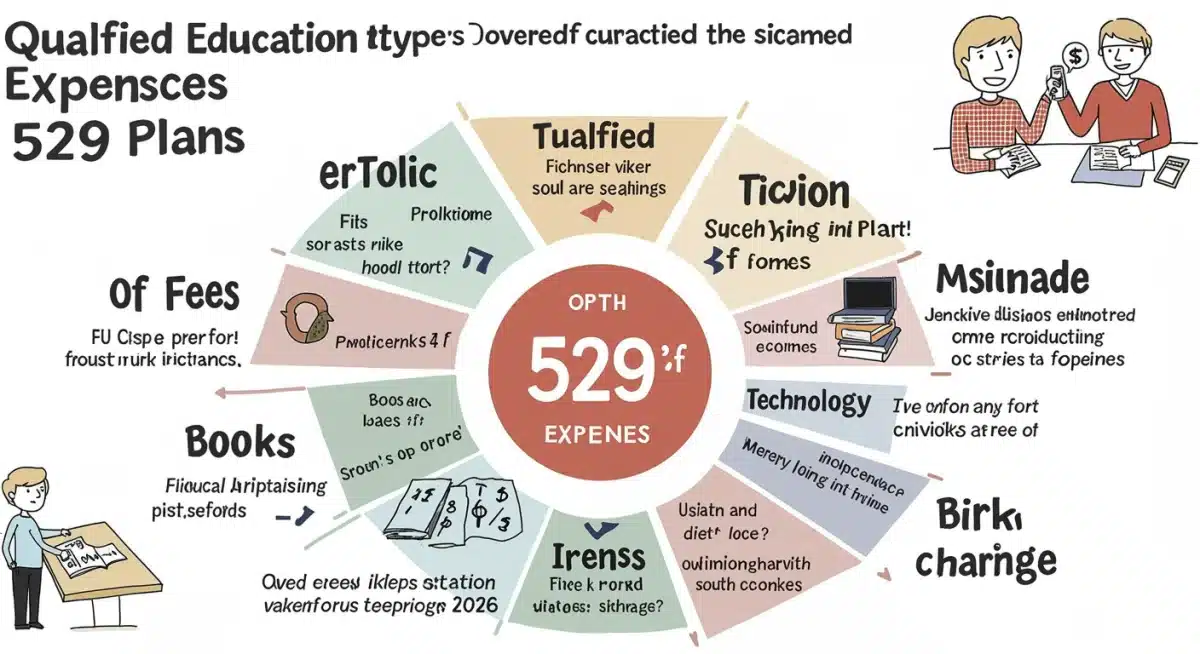
Qualified education expenses are broadly defined and include tuition, fees, books, supplies, and equipment required for enrollment or attendance at an eligible educational institution. This also extends to room and board for students enrolled at least half-time, provided the cost doesn’t exceed the institution’s cost of attendance or the actual amount charged, whichever is greater. In 2026, the definition continues to be comprehensive, adapting to modern educational needs.
Evolving Rules for 2026 and Beyond
Recent legislative changes have expanded the scope of qualified expenses, and this trend is expected to continue into 2026. For instance, K-12 tuition expenses (up to $10,000 per year per beneficiary) and expenses for apprenticeship programs registered with the Department of Labor are now covered. Additionally, beginning in 2024, unused 529 funds can be rolled over to a Roth IRA for the beneficiary, subject to certain limits, offering an unprecedented level of flexibility.
- Tuition and Fees: The most common qualified expense, covering both undergraduate and graduate programs.
- Room and Board: Applicable for students enrolled at least half-time, up to the school’s cost of attendance.
- Books and Supplies: Essential items needed for coursework are covered.
- Computers and Technology: Equipment, software, and internet access used for educational purposes are often included.
- K-12 Tuition: Up to $10,000 annually per beneficiary for private or religious elementary and secondary education.
- Apprenticeship Programs: Fees, books, supplies, and equipment required for registered apprenticeship programs.
- Student Loan Repayment: Up to $10,000 lifetime per beneficiary and $10,000 per sibling for student loan principal and interest.
Careful planning around these rules ensures that every dollar withdrawn from your 529 plan remains tax-free. Keeping abreast of any further legislative updates is vital to making the most of these powerful savings tools and avoiding potential penalties.
Choosing the Right 529 Plan and Investment Strategy
The vast array of 529 plans available can be overwhelming, but selecting the right one and implementing an appropriate investment strategy is critical for successful optimization. While you can invest in any state’s 529 plan, even if you don’t reside there, your home state’s plan might offer unique tax advantages.
When selecting a plan, consider factors such as investment options, fees, historical performance, and state-specific tax benefits. Many plans offer age-based portfolios that automatically adjust their asset allocation as the beneficiary approaches college age, becoming more conservative over time. This hands-off approach can be ideal for many savers, but more experienced investors might prefer to manage their own portfolios.
Investment Considerations for Long-Term Growth
For younger beneficiaries, a more aggressive investment strategy with a higher allocation to equities can be appropriate, aiming for higher growth potential over the long term. As the beneficiary gets closer to needing the funds, shifting towards more conservative investments like bonds and money market funds helps protect the accumulated savings from market volatility.
- Age-Based Portfolios: A popular default option that automatically de-risks investments over time.
- Static Investment Portfolios: For those who prefer a specific asset allocation that remains constant.
- Individual Fund Options: Allows for direct selection of mutual funds or exchange-traded funds (ETFs) offered within the plan.
- Fees: Compare administrative fees, underlying fund fees (expense ratios), and any sales charges. Lower fees mean more of your money working for you.
- Performance: Review historical performance, but remember that past returns do not guarantee future results.
Choosing the right plan and investment strategy requires a balance between risk tolerance, time horizon, and desired level of involvement. Regularly reviewing your chosen plan’s performance and adjusting your strategy as needed is a key component of effective 529 plan optimization.
Adapting to Changing Education Costs and Beneficiary Needs
The dynamic nature of education costs and evolving beneficiary needs necessitates a flexible and adaptable approach to 529 plan management. What might be an optimal strategy today could require adjustments in 2026 or beyond.
Education costs are not static; tuition, fees, and even living expenses can change year by year. Staying informed about these trends, especially at institutions your beneficiary might attend, can help you adjust your contribution strategy. For instance, if a particular university’s tuition is rising faster than anticipated, increasing contributions might be warranted to keep pace with future expenses.
Flexibility in Beneficiary Changes and Rollovers
One of the significant advantages of 529 plans is their inherent flexibility. If the initial beneficiary decides not to pursue higher education, or receives a scholarship that covers most costs, the funds are not lost. You can change the beneficiary to another eligible family member, such as a sibling, cousin, or even the account owner themselves, without incurring taxes or penalties.
Furthermore, as mentioned earlier, the option to roll over unused 529 funds to a Roth IRA starting in 2024 (and continuing into 2026) provides an invaluable safety net. This allows up to $35,000 over a lifetime, subject to annual Roth IRA contribution limits and the 529 account being open for at least 15 years, to be transferred. This flexibility minimizes the risk of over-saving and provides additional retirement planning benefits.
By remaining agile and proactive in managing your 529 plan, you can effectively adapt to unforeseen circumstances and ensure that your savings continue to serve their intended purpose, providing educational opportunities while optimizing financial benefits.
Advanced Strategies for Enhanced 529 Plan Savings
Beyond the foundational principles, several advanced strategies can further enhance your ability to optimize 529 plans and significantly increase your annual savings. These approaches often involve coordinating with other financial vehicles or taking advantage of specific situations.
Consider the impact of grandparents or other family members contributing to a 529 plan. These contributions can also benefit from state tax deductions in some cases, and they reduce the size of the grandparent’s taxable estate. Furthermore, contributions from grandparents have a favorable impact on financial aid eligibility, as they are typically not considered parental assets in the FAFSA calculation, unlike parental 529s which are considered parental assets.
Coordinating with Other Financial Aid and Scholarships
While 529 plans are powerful, they should be viewed as part of a broader financial aid strategy. Encourage your beneficiary to pursue scholarships and grants, which are essentially free money for education. If a beneficiary receives a scholarship, you can withdraw an amount equal to the scholarship from your 529 plan without incurring the 10% penalty on earnings, though any earnings withdrawn would still be subject to income tax.
- Grandparent Contributions: Leverage contributions from grandparents for potential estate planning benefits and favorable financial aid treatment.
- Scholarship Adjustments: Withdraw funds equal to scholarship amounts without penalty, though earnings will be taxed.
- Student Loan Repayment: Use 529 funds to repay up to $10,000 in student loans per beneficiary and per sibling, a significant benefit for managing post-graduation debt.
- Employer Contributions: Some employers offer education benefits that can be coordinated with 529 plans.
- Custodial Accounts (UGMA/UTMA): If a beneficiary has a custodial account, consider using those funds first, as they are generally taxed at the child’s lower rate, before drawing from a 529.
By implementing these advanced strategies, families can create a comprehensive and highly efficient plan for funding education, potentially unlocking additional savings and maximizing the long-term financial impact of their 529 plan. This holistic view ensures that all available resources are utilized effectively.
The Financial Impact: Saving Up to $5,000 Annually
The cumulative effect of carefully executed strategies to optimize 529 plans can lead to remarkable annual savings, potentially reaching up to $5,000 or more for families in 2026. This significant financial impact stems from a combination of tax benefits, smart investment growth, and avoidance of unnecessary expenses or penalties.
Consider a scenario where a family in a state with generous tax deductions contributes strategically, benefits from tax-free growth over many years, and makes qualified withdrawals without incurring federal income tax. The state tax deduction alone could save hundreds or even thousands of dollars annually. When combined with the compounding of tax-free earnings, which can easily amount to thousands over a decade, the total savings become substantial.
Illustrative Savings Breakdown
To put this into perspective, imagine a family contributing $5,000 annually to a 529 plan. If their state offers a 5% tax credit for contributions, that’s an immediate $250 saving. Over 18 years, with an average annual return of 6%, the tax-free growth on those contributions could amount to tens of thousands of dollars in avoided capital gains taxes. When compared to a taxable investment account, the difference in net available funds for education can be staggering.
Furthermore, avoiding the 10% penalty on earnings for non-qualified withdrawals is a critical component of maximizing savings. By carefully planning withdrawals for qualified expenses, families ensure they retain the full benefit of tax-free growth. The ability to roll over unused funds to a Roth IRA also protects against potential losses if the funds are not fully utilized for education, adding another layer of financial efficiency.
Ultimately, the $5,000 annual saving is not an arbitrary figure but a realistic outcome for families who diligently manage and optimize their 529 plans. It represents the power of tax-advantaged savings combined with informed decision-making, providing a tangible pathway to making education more affordable in 2026 and beyond.
| Key Optimization Strategy | Brief Description |
|---|---|
| Maximize State Tax Benefits | Contribute to plans offering state income tax deductions or credits, potentially saving hundreds annually. |
| Understand Qualified Expenses | Ensure withdrawals cover eligible costs like tuition, room, and board to avoid taxes and penalties. |
| Strategic Contributions | Utilize automatic contributions and gift tax exclusions to front-load savings and maximize growth. |
| Leverage Roth IRA Rollover | Convert unused 529 funds to a Roth IRA after 15 years, offering flexibility and retirement savings. |
Frequently Asked Questions About 529 Plans in 2026
In 2026, 529 plans continue to offer tax-free growth on investments and federal income tax-free withdrawals for qualified education expenses. Many states also provide additional tax deductions or credits for contributions, further enhancing the financial advantages for savers.
Yes, as of 2026, 529 plan funds can be used to pay for K-12 tuition expenses, up to $10,000 per year per beneficiary, for public, private, or religious elementary and secondary schools. This flexibility significantly broadens the utility of these plans.
If your child doesn’t use all the funds, you can change the beneficiary to another eligible family member. Alternatively, starting in 2024 and continuing into 2026, unused funds can be rolled over to a Roth IRA for the beneficiary, subject to certain limits and conditions.
No, there are no income limitations for contributing to a 529 plan. Anyone, regardless of their income level, can contribute to a 529 plan. However, contributions are considered gifts and are subject to federal gift tax rules, though generous annual exclusions apply.
529 plans owned by parents are generally considered parental assets on the FAFSA and have a minimal impact on financial aid eligibility (assessed at a maximum of 5.64% of their value). Grandparent-owned 529s typically have an even lesser impact, especially if distributions aren’t counted as student income.
Conclusion
Successfully navigating the complexities of education finance for 2026 requires foresight and strategic action. By actively engaging with and optimizing your 529 plans, families can unlock substantial annual savings, potentially reaching up to $5,000. This involves a comprehensive understanding of tax benefits, meticulous planning of contributions and withdrawals, and a willingness to adapt to evolving educational costs and legislative changes. The proactive approach outlined in this guide empowers families to build a robust financial foundation for their children’s education, transforming what often feels like an insurmountable burden into an achievable goal.