
Bridging the Digital Divide: 3 Federal Programs Offering Internet Access to US Students in 2026
In an increasingly interconnected world, reliable internet access is no longer a luxury but a fundamental necessity, especially for education. For millions of students across the United States, the lack of consistent, high-speed internet – a phenomenon widely known as the digital divide – poses a significant barrier to academic success and equitable opportunity. As we look towards 2026, the federal government has intensified its efforts to tackle this critical issue, implementing and bolstering several key initiatives designed to provide internet access to US students.
This comprehensive article delves into three pivotal federal programs that are at the forefront of bridging this digital divide. We will explore their practical solutions, analyze their financial impact, and discuss how they are shaping the future of education for American youth. Understanding these programs is crucial for educators, policymakers, parents, and communities committed to ensuring that every student has the tools they need to thrive in the 21st century.
The journey to universal internet access for students is complex, involving technological infrastructure, financial investment, and community engagement. However, the commitment from federal bodies underscores a national recognition of the transformative power of digital equity. Let’s uncover how these federal internet programs students are benefiting from are designed to make a tangible difference.
The E-Rate Program: A Cornerstone of Educational Connectivity
The E-Rate program, formally known as the Schools and Libraries Universal Service Support Mechanism, has been a cornerstone of federal efforts to provide affordable internet access to US students since its inception in 1996. Administered by the Universal Service Administrative Company (USAC) under the direction of the Federal Communications Commission (FCC), E-Rate discounts telecommunications, internet access, and internal connections for eligible schools and libraries. For decades, E-Rate has been instrumental in ensuring that educational institutions can afford the necessary infrastructure to support digital learning environments.
Practical Solutions Offered by E-Rate
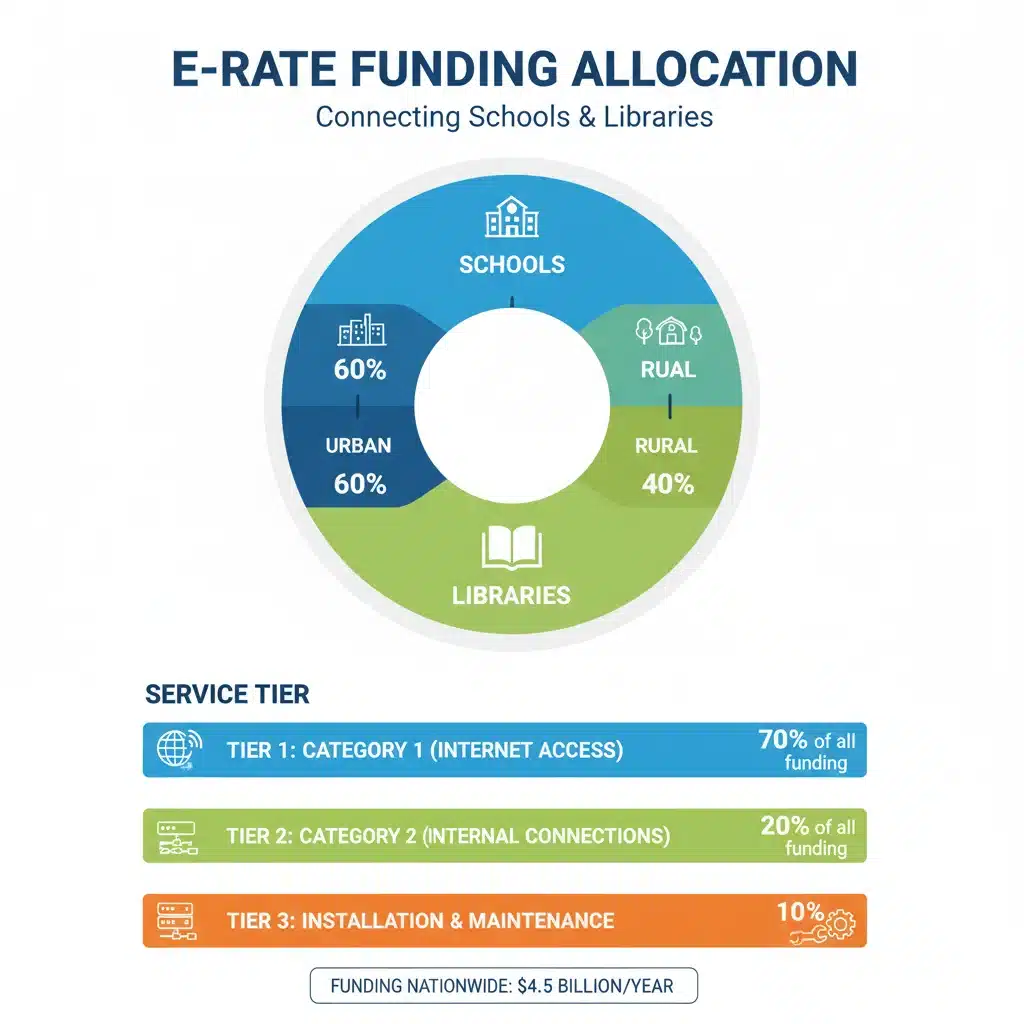
E-Rate offers discounts ranging from 20% to 90% on eligible services, with the discount rate determined by the poverty level of the school or library’s student population and whether the institution is located in a rural or urban area. The program supports two main categories of services:
- Category One (Data Transmission and Internet Access): This covers services that provide connectivity to the internet, such as fiber optic connections, cable modem service, and wireless internet service. Ensuring robust and reliable internet access to US students within school buildings is a primary focus.
- Category Two (Internal Connections, Managed Internal Broadband Services, and Basic Maintenance of Internal Connections): This category supports the technology within schools and libraries that brings internet access to the classroom. This includes Wi-Fi access points, routers, switches, and the maintenance required to keep these systems operational.
By subsidizing these essential services, E-Rate enables schools in even the most underserved areas to upgrade their networks, deploy Wi-Fi throughout their campuses, and provide high-speed internet access to US students, facilitating online learning, research, and digital literacy development. The program’s flexibility allows schools to choose the services that best meet their specific needs, fostering a tailored approach to connectivity.
Financial Impact and Evolution Towards 2026
The financial impact of E-Rate is monumental. Annually, the program disburses billions of dollars in discounts, significantly reducing the financial burden on school districts and library systems. For 2026, the program continues to adapt to evolving technological needs. There’s a growing emphasis on ensuring that not only institutions are connected, but that the bandwidth provided is sufficient to support modern educational demands, including video conferencing, cloud-based applications, and digital content streaming. The program has consistently shown its ability to evolve, for instance, by temporarily expanding to cover internet access for remote learning during the COVID-19 pandemic through the Emergency Connectivity Fund, demonstrating its adaptability and importance in crisis.
As we approach 2026, E-Rate’s role in providing internet access to US students remains indispensable. It’s not just about getting a connection, but ensuring that connection is fast, reliable, and ubiquitous within educational settings. This commitment empowers educators to integrate technology seamlessly into their curriculum, preparing students for a future that is undeniably digital.
Affordable Connectivity Program (ACP): Bringing Internet Home
While E-Rate focuses on institutional connectivity, the Affordable Connectivity Program (ACP) addresses a critical component of the digital divide: home internet access. Launched by the FCC as a successor to the Emergency Broadband Benefit (EBB) program, the ACP provides eligible low-income households with a discount of up to $30 per month towards internet service, and up to $75 per month for households on qualifying Tribal lands. Additionally, many participating internet providers offer a one-time discount of up to $100 for a laptop, desktop computer, or tablet.
Practical Solutions for Students and Families
The ACP is designed to ensure that the internet access to US students extends beyond the school gates into their homes, facilitating homework completion, online research, and continuous learning. For many families, the cost of internet service is a major barrier. By significantly reducing this cost, the ACP removes a substantial hurdle, enabling students to participate fully in hybrid learning models, access educational resources, and develop crucial digital skills in their own environment. This program directly supports the concept of ubiquitous learning, where education is not confined to the classroom.
Eligibility for the ACP is broad, encompassing households that:
- Have an income at or below 200% of the Federal Poverty Guidelines.
- Participate in certain assistance programs, such as SNAP, Medicaid, Federal Public Housing Assistance, SSI, WIC, or Lifeline.
- Are approved for the free or reduced price school lunch program or the school breakfast program, including through the USDA Community Eligibility Provision.
- Received a Federal Pell Grant during the current award year.
- Meet the eligibility criteria for a participating provider’s existing low-income program.
This wide range of eligibility criteria ensures that a significant portion of US students from economically disadvantaged backgrounds can benefit from subsidized internet, directly addressing the home connectivity gap that exacerbates educational inequalities.
Financial Impact and Future Outlook for ACP in 2026
The financial impact of the ACP is felt directly by millions of families who can now afford reliable internet service. This program represents a substantial federal investment in digital equity, with billions of dollars allocated to support household connectivity. For 2026, the continuity and potential expansion of the ACP are critical. While the program has faced funding challenges and political debates regarding its long-term future, its immense success in connecting underserved communities underscores its importance. Advocates continue to push for sustained funding to ensure that the progress made in bridging the home digital divide is not lost. The ability to provide consistent internet access to US students at home is paramount for their academic and personal development, and the ACP is a key mechanism for achieving this goal.
The program not only helps students but also empowers entire families, allowing them to access telehealth services, employment opportunities, and civic engagement resources, thereby fostering broader community upliftment.
Broadband Equity, Access, and Deployment (BEAD) Program: Infrastructure for the Future
Beyond direct subsidies for internet service, the federal government is also investing heavily in the underlying infrastructure required to deliver high-speed internet to all Americans, including students. The Broadband Equity, Access, and Deployment (BEAD) program, established by the Infrastructure Investment and Jobs Act, allocates $42.45 billion to expand high-speed internet access by funding infrastructure deployment and adoption programs. This program is administered by the National Telecommunications and Information Administration (NTIA).
Practical Solutions: Building the Digital Highway
BEAD’s primary objective is to ensure that every American has access to reliable, high-speed internet. This involves funding projects that deploy new broadband infrastructure in unserved and underserved areas, as well as upgrading existing networks to meet future demands. For students, this means that even those in remote rural areas or economically distressed urban neighborhoods, who previously had no access or only very slow connections, will gain the foundational infrastructure necessary for modern learning. The program prioritizes:
- Unserved Locations: Those without access to 25/3 Mbps (download/upload) internet.
- Underserved Locations: Those without access to 100/20 Mbps internet.
- Community Anchor Institutions (CAIs): Such as schools, libraries, and hospitals, ensuring they have robust symmetrical gigabit connectivity.
By focusing on infrastructure, BEAD creates the pathways through which internet access to US students can be delivered effectively. It’s a long-term investment that addresses the root cause of connectivity gaps, laying the groundwork for sustainable digital inclusion. This program ensures that the physical means for connectivity are available, which is a prerequisite for any service-based subsidy program to be truly effective.

Financial Impact and Strategic Vision for 2026 and Beyond
With over $42 billion in funding, BEAD represents an unprecedented federal investment in broadband infrastructure. States and territories are receiving allocations based on their proportion of unserved and underserved locations, allowing for tailored deployment strategies. The financial impact extends beyond just building networks; it stimulates local economies, creates jobs, and fosters innovation in technology deployment.
By 2026, the initial phases of BEAD implementation are expected to be well underway, with significant progress in connecting previously isolated communities. This strategic investment ensures that as technology evolves, the underlying infrastructure can support higher bandwidth demands and more sophisticated educational applications. The program’s focus on future-proof networks means that the internet access to US students provided through BEAD will remain relevant and effective for years to come, preventing a recurrence of the digital divide as technological standards advance.
BEAD also emphasizes digital equity and inclusion, often requiring recipients of funds to offer affordable internet plans and participate in programs like the ACP, creating a synergistic effect between federal initiatives. This integrated approach ensures that infrastructure is built and that the services delivered over that infrastructure are accessible and affordable.
The Collective Impact: Synergy of Federal Internet Programs for Students
While each of these federal internet programs for students operates with distinct objectives and mechanisms, their combined effect creates a powerful, multi-faceted approach to bridging the digital divide. E-Rate ensures schools and libraries are equipped; ACP makes home internet affordable; and BEAD builds the essential infrastructure. Together, they form a comprehensive strategy to provide internet access to US students wherever they learn – in the classroom, at the library, or in their own homes.
The synergy between these programs is critical. For instance, BEAD’s infrastructure build-out makes it possible for more households to access internet services, which can then be made affordable through the ACP. Similarly, schools enhanced by E-Rate can better leverage the home connectivity provided by ACP, creating a more cohesive learning ecosystem. This integrated approach maximizes the impact of federal investments, moving closer to the goal of universal connectivity.
Challenges and Opportunities Ahead for 2026
Despite the robust framework of these programs, challenges remain. These include ensuring equitable distribution of funds, overcoming geographical barriers in remote areas, addressing digital literacy gaps, and navigating the complexities of program administration. For instance, while BEAD aims to build infrastructure, ensuring service providers offer truly affordable plans in those newly connected areas remains a vital step. Similarly, the long-term funding stability of programs like ACP needs continuous advocacy and legislative support.
However, the opportunities presented by these initiatives are immense. By 2026, with continued commitment and effective implementation, we can expect to see a significant reduction in the number of students lacking adequate internet access. This will translate into improved academic outcomes, enhanced digital skills for the future workforce, and greater equity in educational opportunities across all demographics. The ability to access online resources, engage in remote learning, and connect with global information becomes a universal standard, not a privilege.
Furthermore, these programs foster innovation. As more students gain internet access, the demand for high-quality digital educational content and tools will grow, spurring further development in educational technology. This creates a virtuous cycle where connectivity drives innovation, which in turn enhances learning experiences.
Conclusion: A Connected Future for US Students
The federal government’s commitment to bridging the digital divide for US students by 2026 is clear through the robust support mechanisms of the E-Rate program, the Affordable Connectivity Program (ACP), and the Broadband Equity, Access, and Deployment (BEAD) program. These initiatives represent a strategic and substantial investment in the future of American education, recognizing that internet access is a foundational element for success in the modern era.
From ensuring that schools have the necessary bandwidth to making home internet affordable for low-income families, and from building critical infrastructure in unserved areas, these federal internet programs for students are systematically dismantling barriers to digital inclusion. The practical solutions they offer are tangible, and their financial impact is transformative, creating a more equitable landscape for learning.
As we move towards 2026, the ongoing success of these programs will depend on continued federal funding, effective state-level implementation, and strong community partnerships. By working together, we can ensure that every student in the United States has the opportunity to harness the power of the internet, unlocking their full potential and contributing to a more connected and prosperous society. The vision of universal internet access to US students is not just an aspiration; it is rapidly becoming a reality, paving the way for a brighter, more equitable educational future.