
Optimizing Your Social Security in 2026: 3 Key Strategies to Increase Your Monthly Payout by 10% (FINANCIAL IMPACT)
Anúncios
As we approach 2026, many individuals are beginning to seriously consider their retirement plans, and for good reason. Social Security benefits often form the bedrock of financial security for millions of retirees. However, simply claiming your benefits without a strategic approach can leave significant money on the table. The good news is that with careful planning and an understanding of the rules, you can implement effective Social Security Optimization 2026 strategies to boost your monthly payout, potentially by 10% or more. This comprehensive guide will delve into three crucial strategies that can make a substantial financial impact on your retirement years.
Understanding the nuances of Social Security is paramount. It’s not just about when you claim, but also how your work history, earnings, and even spousal benefits play a role. The decisions you make today, or in the very near future, will directly affect the income you receive throughout your retirement. For 2026, while the core rules are expected to remain consistent, staying informed about potential cost-of-living adjustments (COLAs) and other legislative changes is always wise. Our focus here is on timeless strategies that empower you to take control and maximize your Social Security benefits.
Many people assume Social Security is a fixed calculation, but there’s considerable flexibility. By leveraging specific claiming strategies, understanding how earnings records impact benefits, and exploring spousal or survivor benefits, you can significantly enhance your financial outlook. This article aims to demystify these options, providing actionable insights for anyone looking to optimize their Social Security in 2026 and beyond. Let’s explore how to turn these complex rules into a clear pathway for increased financial security.
Anúncios
Strategy 1: The Power of Delayed Claiming for Higher Monthly Benefits
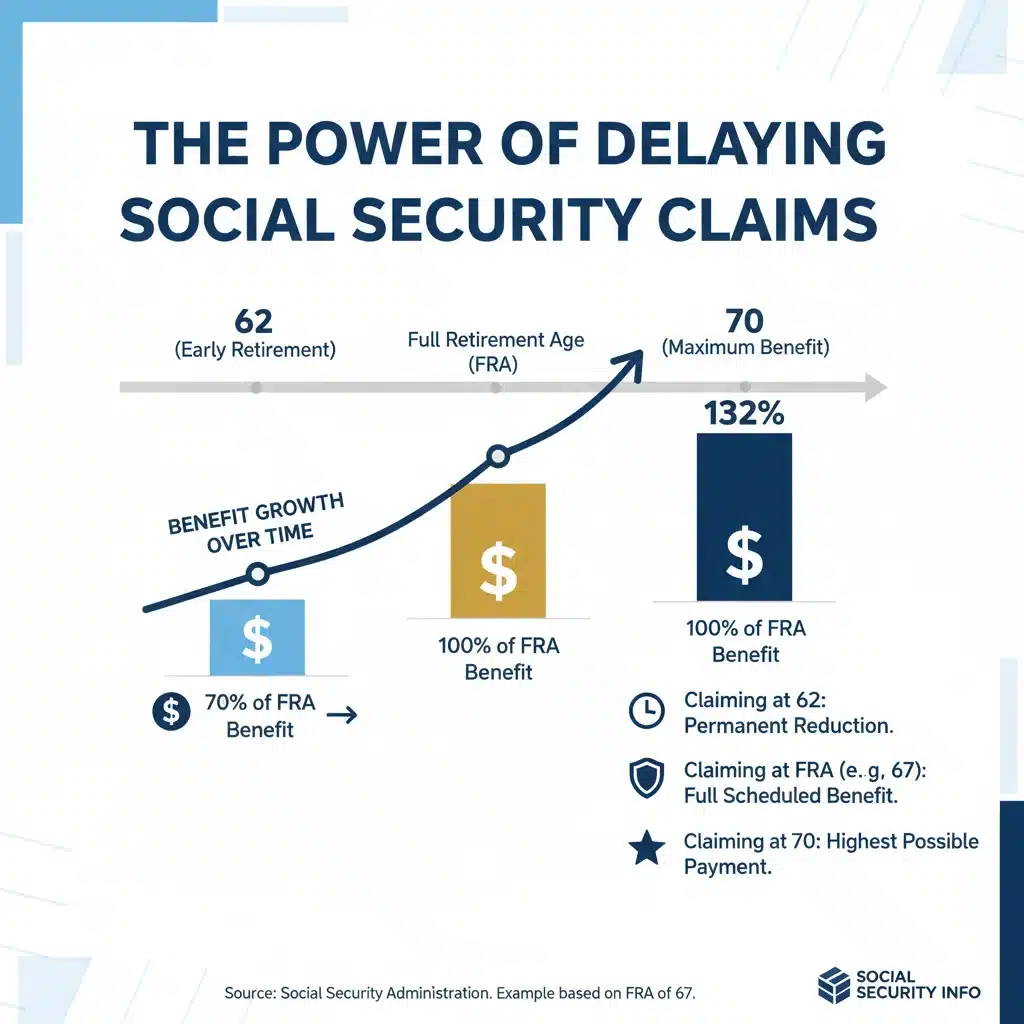
One of the most impactful Social Security Optimization 2026 strategies is delaying when you begin receiving benefits. While you can start claiming as early as age 62, doing so results in a permanent reduction of your monthly payment. Conversely, waiting beyond your Full Retirement Age (FRA) – which is typically between 66 and 67, depending on your birth year – can significantly increase your monthly check. For each year you delay claiming past your FRA, up to age 70, your benefit amount increases by approximately 8% per year. This is known as Delayed Retirement Credits (DRCs).
Consider the financial implications: if your Full Retirement Age is 67, and you delay claiming until age 70, you could see a 24% increase in your monthly benefit compared to claiming at FRA. If you claim at 62, your benefit could be reduced by up to 30%. The difference between claiming at 62 and 70 can be staggering, potentially leading to a 76% higher monthly payment. This substantial increase is a powerful incentive for those who are able to defer their benefits.
The decision to delay claiming isn’t always straightforward. It often depends on your health, other sources of retirement income, and your current financial needs. If you are still working, or have sufficient savings to cover your expenses until age 70, delaying your claim can be a financially savvy move. This strategy not only provides a larger monthly income stream but also offers a measure of inflation protection, as your higher starting benefit will be subject to future Cost-of-Living Adjustments (COLAs).
For individuals approaching retirement in 2026, understanding their specific Full Retirement Age is the first step. The Social Security Administration (SSA) provides detailed information on their website, or you can check your annual Social Security statement. Once you know your FRA, you can model different claiming scenarios to see the potential impact on your monthly benefit. This foresight is a cornerstone of effective Social Security Optimization 2026.
Many financial advisors recommend viewing Social Security as a form of longevity insurance. By maximizing your monthly benefit through delayed claiming, you are essentially guaranteeing a higher income stream for as long as you live, which can be invaluable in your later years. This is especially critical as life expectancies continue to rise. A higher monthly check means greater purchasing power and a more comfortable retirement, making delayed claiming a potent tool in your Social Security arsenal.
Strategy 2: Maximizing Benefits Based on Your Earnings Record and Work History
Your Social Security benefits are calculated based on your highest 35 years of earnings. This fundamental rule holds significant weight in Social Security Optimization 2026. If you have fewer than 35 years of earnings, or if some of those years involved low income, those years will be counted as zeros in the calculation, effectively lowering your overall benefit. This highlights the importance of a long and consistent work history, especially during your peak earning years.
For those nearing retirement, a strategic move might be to work a few extra years, particularly if your current earnings are higher than some of your earlier, lower-earning years. By doing so, you can replace a year of low or zero earnings with a year of high earnings, which will increase your average indexed monthly earnings (AIME) and, consequently, your primary insurance amount (PIA). This can directly translate to a higher monthly Social Security check.
It’s crucial to regularly review your Social Security earnings record, which you can access through your personal mySocialSecurity account on the SSA website. Errors in reporting earnings can occur, and correcting them promptly can prevent a reduction in your future benefits. Ensuring your earnings record is accurate is a simple yet vital step in Social Security Optimization 2026. Any discrepancies should be addressed immediately with the Social Security Administration.
Furthermore, if you’ve taken time out of the workforce for caregiving or other reasons, returning to work for a few years before retirement could significantly impact your benefit calculation. Even part-time work, if it replaces a year of zero earnings, can provide a boost. The key is to understand your individual earnings history and project how additional work years might influence your highest 35 years of earnings.
This strategy also underscores the importance of continued financial planning. If you anticipate a period of lower earnings, or a gap in employment, understanding its long-term effect on your Social Security can help you plan accordingly. For instance, you might choose to save more aggressively during your high-earning years to compensate for potential dips in your earnings record, or to enable you to delay claiming your benefits later on.
In essence, actively managing your earnings record and work history is a proactive approach to maximizing your Social Security benefits. It’s about leveraging your professional trajectory to ensure that your retirement income reflects your full earning potential, making it a cornerstone of effective Social Security Optimization 2026.
Strategy 3: Leveraging Spousal and Survivor Benefits
Social Security benefits are not solely based on an individual’s work record. Spousal and survivor benefits offer significant opportunities for Social Security Optimization 2026, particularly for married couples, divorced individuals, and widows/widowers. Understanding these rules can lead to a substantially higher combined household income in retirement.
Spousal Benefits
If you are married, you may be eligible to receive a spousal benefit based on your spouse’s work record, even if you have your own earnings record. A spousal benefit can be up to 50% of your spouse’s Full Retirement Age (FRA) benefit. You can claim spousal benefits if your own benefit is less than 50% of your spouse’s, or if you haven’t worked enough to qualify for your own benefits. However, you can only claim spousal benefits when your spouse has already filed for their own benefits.
A common strategy for couples involves one spouse (typically the higher earner) delaying their claim until age 70 to maximize their individual benefit, while the other spouse claims a spousal benefit at their FRA. This allows the couple to receive some income while the higher earner’s benefit continues to grow. Once the higher earner claims at 70, the other spouse might then switch to their own maximized benefit if it’s higher than their spousal benefit. This coordinated claiming is a powerful Social Security Optimization 2026 tactic.
For divorced individuals, if your marriage lasted at least 10 years and you are currently unmarried, you may be eligible for benefits based on your ex-spouse’s record. This is true even if your ex-spouse has remarried, and they do not need to be aware of your claim. This can be a vital source of income for many, and it’s an often-overlooked aspect of Social Security Optimization 2026.
Survivor Benefits
If your spouse passes away, you may be eligible for survivor benefits. A widow or widower can receive up to 100% of the deceased spouse’s benefit amount. The earliest you can claim survivor benefits is age 60 (or age 50 if you are disabled). However, similar to individual benefits, claiming survivor benefits before your own Full Retirement Age will result in a reduced payment.
A smart strategy for widows and widowers involves carefully timing their claim. For instance, a surviving spouse might claim their own reduced benefit early (at age 62) and then switch to their maximized survivor benefit at their Full Retirement Age, or vice-versa. Or, they might claim the survivor benefit early and allow their own benefit to grow until age 70. The optimal strategy depends on the individual’s specific circumstances, including their age, health, and the benefit amounts. This careful planning is a crucial part of Social Security Optimization 2026.
It’s important to note that you cannot claim both a spousal/survivor benefit and your own full retirement benefit simultaneously. The SSA will pay you the higher of the two. Therefore, understanding your options and strategically choosing when to claim each type of benefit is essential for maximizing your overall payout. Consulting with a financial advisor specializing in Social Security can be incredibly beneficial for navigating these complex rules and ensuring you make the most informed decisions.

Putting It All Together: A Holistic Approach to Social Security Optimization 2026
While each of these strategies – delayed claiming, maximizing earnings, and leveraging spousal/survivor benefits – can independently boost your Social Security payout, their true power lies in their combined application. A holistic approach to Social Security Optimization 2026 considers all these elements in the context of your unique financial situation, health, and retirement goals.
For many, the journey to a secure retirement begins with a thorough assessment of their current financial standing. This includes understanding all sources of income, evaluating savings and investments, and projecting future expenses. Only then can you realistically determine how much you can afford to delay claiming Social Security, or if working a few extra years makes sense. The goal is to create a comprehensive retirement plan where Social Security plays its most effective role.
Consider the interplay of these strategies. If you have a strong earnings record, delaying your claim will result in even higher Delayed Retirement Credits. If you are married, coordinating your claiming strategy with your spouse can lead to a significantly larger combined lifetime benefit. For those who are divorced or widowed, understanding the specific rules for survivor and divorced-spousal benefits can unlock substantial financial support that might otherwise be overlooked.
The landscape of retirement planning is constantly evolving, and while the core principles of Social Security remain, staying informed is key. The Social Security Administration’s website (SSA.gov) is an invaluable resource for checking your earnings record, estimating benefits, and understanding the latest rules. However, for personalized advice and complex situations, engaging with a qualified financial advisor who specializes in Social Security can provide immense value. They can help you model various scenarios, identify potential pitfalls, and ensure you are making the most advantageous decisions for your unique circumstances.
Remember, the decisions you make regarding your Social Security benefits are often irreversible once you start claiming. Therefore, taking the time to research, plan, and seek expert advice before 2026 is crucial. By proactively engaging in Social Security Optimization 2026, you empower yourself to achieve a more financially stable and comfortable retirement, potentially increasing your monthly payout by that critical 10% or more.
The Financial Impact of Smart Social Security Choices
The difference between a well-thought-out Social Security strategy and a hasty decision can be tens of thousands, if not hundreds of thousands, of dollars over the course of your retirement. A 10% increase in your monthly payout, achieved through diligent Social Security Optimization 2026, might seem modest on a monthly basis, but it compounds significantly over two or three decades of retirement.
For example, if your Full Retirement Age benefit is $2,000 per month, a 10% increase means an extra $200 per month. Over 20 years, that’s an additional $48,000. If you live longer, as many retirees do, this figure grows even more substantially. This additional income can provide a buffer against unexpected expenses, allow for more leisure activities, or simply offer greater peace of mind.
Moreover, Social Security benefits are inflation-adjusted through annual Cost-of-Living Adjustments (COLAs). A higher starting benefit means that every future COLA will be applied to a larger base, further amplifying the long-term financial impact of your initial optimization strategies. This makes Social Security Optimization 2026 not just about today’s dollars, but about preserving your purchasing power for decades to come.
Beyond the direct financial gain, optimizing your Social Security provides a psychological benefit. Knowing that you’ve made informed decisions to maximize this vital retirement income stream can reduce financial stress and allow you to fully enjoy your golden years. It’s about taking control of your financial destiny rather than passively accepting whatever benefit amount comes your way.
In conclusion, approaching Social Security with a strategic mindset for 2026 is not just recommended; it’s essential for anyone serious about their retirement security. By understanding and applying the three key strategies discussed – delayed claiming, maximizing your earnings record, and leveraging spousal/survivor benefits – you can significantly enhance your monthly payout and ensure a more comfortable and financially resilient retirement. Start planning today to unlock the full potential of your Social Security benefits.