
ACA Subsidies 2026: Unlock Up to 80% Off Your Health Insurance Premiums
Navigating the complex world of health insurance can often feel like a daunting task, especially when trying to balance comprehensive coverage with affordability. For many Americans, the cost of health insurance premiums can be a significant burden, making access to essential healthcare seem out of reach. However, the Affordable Care Act (ACA), often referred to as Obamacare, continues to provide a vital lifeline through its robust subsidy programs. As we look ahead to 2026, understanding how these ACA subsidies work and how to maximize your eligibility can mean the difference between struggling to pay for care and securing high-quality health insurance at a fraction of the cost.
The promise of up to 80% off your premiums is not an exaggeration for many eligible individuals and families. This comprehensive guide will delve deep into the intricacies of ACA subsidies for 2026, breaking down eligibility requirements, explaining how premium tax credits are calculated, and offering practical strategies to ensure you receive the maximum financial assistance available. We’ll explore the factors influencing subsidy amounts, the crucial role of the Health Insurance Marketplace, and what you need to know to prepare for open enrollment. By the end of this article, you’ll be equipped with the knowledge to confidently navigate the process and significantly reduce your healthcare expenses.
Understanding ACA Subsidies: The Foundation of Affordable Healthcare
At its core, the Affordable Care Act was designed to expand access to affordable health insurance. A cornerstone of this mission is the provision of financial assistance, primarily through premium tax credits and cost-sharing reductions. These subsidies are not a handout but a mechanism to make health insurance premiums and out-of-pocket costs more manageable for low- and middle-income individuals and families.
For 2026, the framework for ACA subsidies remains largely consistent with recent years, though it’s always wise to stay informed about any potential legislative changes. The primary goal is to cap the percentage of your household income that you are required to spend on health insurance premiums. If your income falls within certain federal poverty level (FPL) guidelines, you could qualify for substantial assistance, making health insurance significantly more affordable.
It’s important to distinguish between the two main types of ACA subsidies:
- Premium Tax Credits (PTC): These are funds that reduce your monthly health insurance premium. You can choose to have these credits paid directly to your insurance company each month, lowering your out-of-pocket payment, or you can claim the full amount when you file your federal income tax return. Most people opt for the upfront payment to ease monthly budgeting.
- Cost-Sharing Reductions (CSRs): These subsidies help lower your out-of-pocket costs, such as deductibles, co-payments, and co-insurance. Unlike premium tax credits, CSRs are only available if you enroll in a Silver-level plan on the Marketplace. If you qualify, your Silver plan will have enhanced benefits, effectively making it more generous than a standard Silver plan.
The interplay of these two types of subsidies can lead to significant savings. For instance, someone with a modest income might not only pay very little for their monthly premium thanks to premium tax credits but also benefit from lower deductibles and co-pays through cost-sharing reductions, making their overall healthcare expenses much more predictable and affordable.
Who Qualifies for ACA Subsidies in 2026? Eligibility Criteria Explained
Eligibility for ACA subsidies in 2026 primarily hinges on your household income relative to the Federal Poverty Level (FPL) and whether you have access to other affordable health coverage. Understanding these criteria is the first step toward unlocking your savings.
Income Requirements
The most significant factor in determining your eligibility for ACA subsidies is your household income. For 2026, individuals and families with incomes between 100% and 400% of the FPL are generally eligible for premium tax credits. However, it’s crucial to note that temporary enhancements made permanent by recent legislation have expanded eligibility, essentially removing the ‘subsidy cliff’ for many. This means that even if your income is above 400% FPL, you may still qualify for assistance if the cost of the benchmark Silver plan (the second-lowest cost Silver plan in your area) would exceed 8.5% of your household income.
For cost-sharing reductions, the income thresholds are typically lower, generally for those with incomes between 100% and 250% of the FPL. It’s important to remember that these FPL percentages are updated annually, so it’s essential to check the most current figures for 2026 closer to open enrollment.
Household Size and Modified Adjusted Gross Income (MAGI)
Your household size plays a critical role in determining your FPL percentage. A larger household means a higher FPL threshold. When applying for subsidies, the Marketplace will ask for your estimated Modified Adjusted Gross Income (MAGI). MAGI is generally your adjusted gross income (AGI) plus certain tax-exempt interest, non-taxable Social Security benefits, and excluded foreign income. Accurate estimation of your MAGI is paramount, as discrepancies can lead to needing to repay excess subsidies or receiving a larger refund at tax time.
No Access to Affordable Employer-Sponsored Coverage
To qualify for ACA subsidies, you generally cannot be offered affordable health coverage through an employer (either your own or a family member’s). Employer-sponsored coverage is considered ‘affordable’ if the employee’s share of the premium for self-only coverage is less than a certain percentage (adjusted annually, around 9.12% for 2026) of their household income. If your employer offers affordable, minimum-value coverage, you typically won’t qualify for ACA subsidies.
There’s also a ‘family glitch’ fix that addresses situations where family coverage through an employer is unaffordable, even if self-only coverage is considered affordable. This fix allows family members to qualify for ACA subsidies even if the employee doesn’t, provided the employer’s family coverage is deemed unaffordable.
Other Important Considerations
- Lawful Presence: You must be a U.S. citizen or lawfully present immigrant to qualify.
- Not Incarcerated: Individuals who are incarcerated are generally not eligible.
- Medicare/Medicaid Eligibility: If you are eligible for Medicare or Medicaid, you typically won’t qualify for ACA subsidies, as these programs are considered comprehensive coverage.
Calculating Your Potential Savings: How ACA Subsidies Work
The calculation of ACA subsidies, specifically premium tax credits, is designed to ensure that individuals and families pay no more than a certain percentage of their income for health insurance premiums. This percentage varies based on your income level relative to the FPL. The lower your income, the lower the percentage you are expected to contribute, and thus, the higher your subsidy.
The Benchmark Plan and Income Tiers
The amount of your premium tax credit is determined by comparing your expected contribution (a percentage of your income) to the cost of the second-lowest cost Silver plan available in your area on the Marketplace. This is known as the ‘benchmark plan.’ Your subsidy covers the difference between your expected contribution and the benchmark plan’s premium.
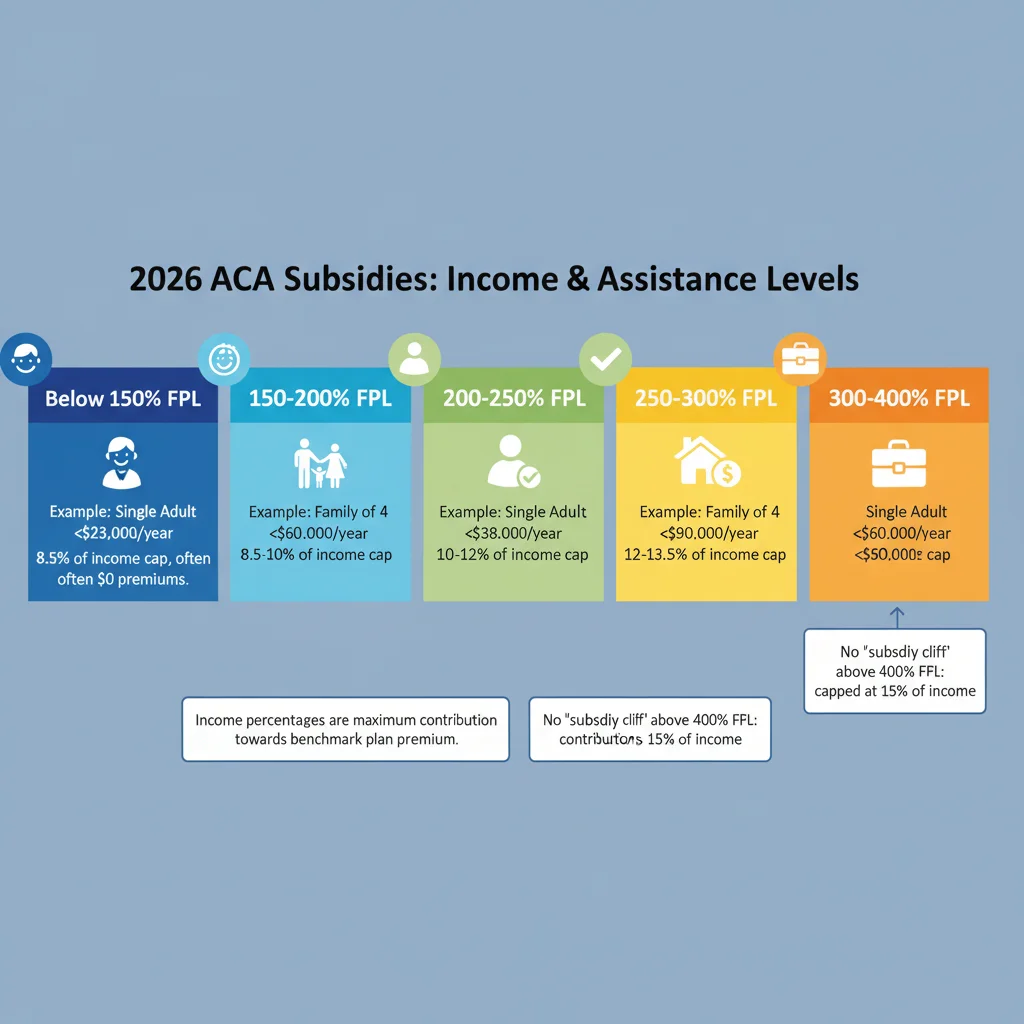
For 2026, the income contribution percentages are structured in tiers. While the exact percentages are subject to slight adjustments annually, here’s a general idea of how they work:
- 100% – 150% FPL: Individuals in this income bracket may pay little to no premium, with a target contribution often around 0% of their income. They also qualify for the most generous cost-sharing reductions.
- 150% – 200% FPL: Expected contribution gradually increases, but still remains very low, often in the range of 0% to 2% of income. Significant cost-sharing reductions are also available.
- 200% – 250% FPL: Expected contribution continues to rise, typically up to around 4% of income. Cost-sharing reductions are still available, though less generous than lower income tiers.
- 250% – 400% FPL: Expected contribution may range from approximately 4% to 8.5% of income. Premium tax credits are available to keep premiums within this cap.
- Above 400% FPL: As mentioned, thanks to the elimination of the ‘subsidy cliff,’ individuals and families above 400% FPL can still qualify for subsidies if their benchmark plan premium would exceed 8.5% of their income. The subsidy will cover the difference to bring their premium down to that 8.5% cap.
It’s this tiered system and the cap on premium spending that allows many to achieve savings of up to 80% or more on their monthly health insurance costs.
Example Scenario
Let’s consider a hypothetical family of four with an estimated MAGI of $60,000 in 2026. If the FPL for a family of four is around $30,000, their income would be 200% of the FPL. According to the tiered structure, their expected contribution for health insurance might be capped at, say, 2% of their income, which is $1,200 per year or $100 per month.
If the benchmark Silver plan in their area costs $1,000 per month, their premium tax credit would be $900 per month ($1,000 – $100). This means they would pay only $100 per month for a Silver plan, and they would also qualify for significant cost-sharing reductions, lowering their deductibles and co-pays. This represents a massive saving, potentially up to 90% off the full premium cost.
Applying for ACA Subsidies in 2026: A Step-by-Step Guide
Applying for ACA subsidies is integrated directly into the Health Insurance Marketplace application process. The system is designed to automatically determine your eligibility for financial assistance based on the information you provide. Here’s how to navigate the process for 2026:
Step 1: Gather Necessary Information
Before you begin, have the following information ready for yourself and anyone else in your household who needs coverage:
- Personal Information: Names, birth dates, Social Security numbers (or document numbers for lawfully present immigrants).
- Income Information: Estimated household income for 2026 (including wages, salaries, self-employment income, Social Security benefits, retirement income, etc.). Recent pay stubs, W-2s, and tax returns can help with your estimate.
- Tax Filing Status: How you plan to file your 2026 federal income taxes (e.g., single, married filing jointly).
- Current Health Coverage: Information about any current health insurance plans you or your family members have.
- Employer Health Coverage: Details about any employer-sponsored health coverage available to you or your family, including the cost of the employee-only premium.
Step 2: Visit the Health Insurance Marketplace
For most states, this means going to HealthCare.gov. Some states operate their own marketplaces, so if you live in one of those states (e.g., California, New York, Washington), you’ll use their specific website. You can find links to state marketplaces on HealthCare.gov.
Step 3: Create an Account and Start Your Application
You’ll need to create an account with a username and password. Once logged in, begin the application process. The application will ask a series of questions about your household, income, and current health coverage status.
Step 4: Provide Accurate Income Estimates for 2026
This is arguably the most critical part of the application for subsidy determination. You’ll need to estimate your household’s Modified Adjusted Gross Income (MAGI) for the upcoming year (2026). Be as accurate as possible. If your income changes significantly during the year, you must update your information on the Marketplace to avoid issues at tax time.
Step 5: Review Your Eligibility Results
After completing the income and household information, the Marketplace will automatically calculate your eligibility for premium tax credits and cost-sharing reductions. It will display the amount of financial assistance you qualify for.
Step 6: Compare Plans and Enroll
Once you know your subsidy amount, you can compare different health plans available in your area. The Marketplace will show you the cost of each plan after your premium tax credit is applied. Remember:
- Premium Tax Credits: Can be applied to any metal-tier plan (Bronze, Silver, Gold, Platinum).
- Cost-Sharing Reductions: Only apply to Silver plans. If you qualify for CSRs, a Silver plan will offer you the best value, with lower deductibles and co-pays.
Select the plan that best fits your healthcare needs and budget, then proceed to enroll.

Maximizing Your Savings: Strategies for 2026
Simply qualifying for ACA subsidies is a great start, but there are additional strategies you can employ to ensure you’re getting the most out of the financial assistance available in 2026.
Accurate Income Estimation is Key
As mentioned, your estimated MAGI for 2026 is the primary driver of your subsidy amount. If you underestimate your income, you might receive more in advance premium tax credits than you’re eligible for, potentially leading to a repayment at tax time. Conversely, overestimating could mean you miss out on upfront savings and have to wait for a larger tax refund. Review your income projections carefully, considering any expected changes in employment, salary, or other income sources.
Update Your Information Promptly
Life happens. If your income or household size changes during 2026 (e.g., a new job, marriage, birth of a child, divorce), it’s crucial to update your application on the Marketplace as soon as possible. These changes can significantly impact your subsidy eligibility and amount. Prompt updates help ensure you receive the correct amount of assistance throughout the year and avoid surprises at tax time.
Consider Silver Plans for Cost-Sharing Reductions
If your income qualifies you for cost-sharing reductions (generally between 100% and 250% FPL), enrolling in a Silver plan is almost always the best financial decision. A Silver plan with CSRs provides better benefits (lower deductibles, co-pays, and out-of-pocket maximums) than a standard Silver plan, often at a premium comparable to or even lower than a Bronze plan after premium tax credits. Don’t overlook this crucial benefit!
Shop Around During Open Enrollment
Even if you were happy with your plan last year, new plans emerge, and existing plans change their benefits and prices annually. Your benchmark plan, which dictates your subsidy amount, can also change. Every open enrollment period, take the time to compare all available plans on the Marketplace. You might find a better plan with lower out-of-pocket costs or a more suitable network of providers, all while still benefiting from your ACA subsidies.
Understand the ‘Family Glitch’ Fix
If you or your family members previously couldn’t get subsidies because of the ‘family glitch,’ make sure to re-evaluate your eligibility for 2026. The fix allows family members to qualify for subsidies if employer-sponsored family coverage is deemed unaffordable, even if the employee’s self-only coverage is affordable. This could open up significant savings for many families.
Seek Assistance from Navigators or Certified Assisters
The Health Insurance Marketplace offers free, unbiased assistance from navigators and certified application counselors. These individuals are trained to help you understand your options, estimate your income, complete the application, and enroll in a plan. Don’t hesitate to use these resources, especially if you find the process confusing.
The Financial Impact: Beyond Premiums
While the focus is often on reducing monthly premiums, the financial impact of ACA subsidies extends far beyond that. Access to affordable health insurance means:
- Protection Against Catastrophic Costs: Health emergencies can lead to crippling medical debt. With comprehensive insurance, even with a deductible, your out-of-pocket maximum limits your financial exposure, providing peace of mind.
- Access to Preventive Care: ACA plans cover essential health benefits, including preventive services like screenings, immunizations, and wellness visits, often at no additional cost. Regular preventive care can catch health issues early, preventing more serious and costly conditions down the line.
- Improved Health Outcomes: When healthcare is affordable, people are more likely to seek necessary medical attention, manage chronic conditions, and adhere to treatment plans, leading to better overall health and quality of life.
- Financial Stability: Reducing a major household expense like health insurance premiums frees up funds for other necessities, contributing to greater financial stability for families.
The ability to secure up to 80% off your premiums through ACA subsidies in 2026 is not just about saving money; it’s about safeguarding your health and financial future.
What to Expect in 2026: A Look Ahead
While the core structure of ACA subsidies is expected to remain stable due to the permanent enhancements, it’s always wise to be prepared for the upcoming open enrollment period for 2026. Here are a few things to keep in mind:
- Open Enrollment Dates: Typically, Open Enrollment for the following year begins on November 1st and runs through January 15th. Mark your calendars and plan to apply or re-enroll early to ensure continuous coverage.
- Annual FPL Updates: The Federal Poverty Level guidelines are updated annually, usually in January. These updates will influence the exact income thresholds for subsidy eligibility. Stay tuned for the official FPL numbers for 2026.
- Plan Changes: Insurance companies frequently adjust their offerings, networks, and prices. Even if you love your current plan, it’s crucial to review it during open enrollment to ensure it still meets your needs and budget.
- Policy Landscape: While major changes to the ACA’s subsidy structure are less likely given recent legislative actions, staying informed about broader healthcare policy discussions is always beneficial.
By proactively engaging with the Marketplace and understanding the nuances of ACA subsidies, you can confidently approach 2026 knowing you’re making the most informed decisions for your health insurance needs.
Conclusion: Secure Your Affordable Health Coverage in 2026
The Affordable Care Act continues to be a cornerstone of accessible healthcare in the United States, and its subsidy programs are more vital than ever. For 2026, the opportunity to secure significant financial assistance, potentially reducing your health insurance premiums by up to 80%, is a reality for millions of Americans. By understanding the eligibility criteria, accurately estimating your income, and actively engaging with the Health Insurance Marketplace, you can unlock these crucial savings.
Don’t let the complexity of health insurance deter you. Take advantage of the resources available, from online tools to certified assisters, to navigate the application process. Remember that ACA subsidies are designed to make quality health coverage affordable, protecting you and your family from unexpected medical costs and ensuring access to essential care. Prepare for open enrollment, assess your options diligently, and confidently step into 2026 with the peace of mind that comes from secure, affordable health insurance.