Micro-Credentials vs. Degrees: 2026 US Job Market Career Advancement

Anúncios
Micro-Credentialing vs. Traditional Degrees: A 2026 US Job Market Analysis for Career Advancement
The landscape of education and employment is undergoing a seismic shift, driven by rapid technological advancements, evolving industry demands, and a globalized workforce. As we peer into the 2026 US job market, a critical question arises for individuals seeking career advancement and employers searching for skilled talent: What holds more weight – the time-honored traditional degree or the agile, specialized micro-credential? This comprehensive analysis delves into the intricate dynamics of both educational pathways, examining their relevance, benefits, challenges, and ultimate impact on career trajectories in the coming years. Understanding the role of micro-credentials job market influence is paramount for navigating future professional success.
Anúncios
The Traditional Degree: Enduring Value in a Changing World
For centuries, the traditional four-year bachelor’s degree, followed often by master’s or doctoral programs, has been the gold standard for higher education and a gateway to professional opportunities. These degrees are designed to provide a broad, foundational knowledge base, critical thinking skills, and a holistic understanding of a discipline. They emphasize theoretical frameworks, research methodologies, and often include liberal arts components intended to foster well-rounded individuals.
Foundational Knowledge and Critical Thinking
One of the undeniable strengths of a traditional degree lies in its ability to cultivate deep foundational knowledge. Students spend years immersing themselves in a subject, learning its history, theories, and methodologies. This extensive exposure builds a robust intellectual framework, enabling graduates to approach complex problems with a comprehensive understanding. The emphasis on critical thinking, analytical reasoning, and problem-solving through extensive coursework, essays, and projects equips individuals with transferable skills highly valued across various industries. These are not merely technical skills but cognitive abilities that underpin adaptability and innovation.
Networking and Soft Skills Development
University campuses are vibrant ecosystems that foster invaluable networking opportunities. Students interact with peers from diverse backgrounds, faculty members who are experts in their fields, and alumni who have established careers. These connections can be pivotal for internships, mentorships, and future job prospects. Beyond academic learning, traditional degrees often provide a structured environment for developing crucial soft skills: communication, teamwork, leadership, time management, and resilience. Participation in student organizations, group projects, and presentations hones these interpersonal abilities, which are increasingly recognized as essential for success in any professional role. The micro-credentials job market, while focused on specific skills, often assumes a baseline of these broader competencies.
Anúncios
Employer Perception and Career Trajectories
Historically, employers have viewed traditional degrees as a reliable indicator of an applicant’s intelligence, discipline, and ability to commit to long-term goals. For many established professions – such as medicine, law, engineering, and academia – a specific degree remains a non-negotiable prerequisite. A traditional degree can open doors to entry-level positions in large corporations, government agencies, and research institutions, often leading to structured career paths with clear advancement opportunities. It signifies a certain level of comprehensive knowledge and a proven ability to complete rigorous academic work, signaling a strong work ethic and intellectual capacity to potential employers.
Challenges of Traditional Degrees in 2026
Despite their enduring value, traditional degrees face increasing scrutiny in the modern era. The rising cost of tuition, coupled with significant student loan debt, makes the return on investment a major concern for many. Furthermore, the pace of technological change often means that some specialized knowledge acquired during a four-year program can become outdated by the time a student graduates. The longer duration of these programs can also delay entry into the workforce, potentially putting graduates at a disadvantage in fast-moving industries. While traditional degrees offer breadth, they sometimes lack the immediate, targeted skill sets demanded by today’s dynamic job market, where the micro-credentials job market is gaining traction.
The Rise of Micro-Credentials: Agility and Specialization
Micro-credentials represent a paradigm shift in education – shorter, focused programs or certifications that validate specific skills or competencies. These can range from digital badges for completing a short course on a particular software to professional certifications in cybersecurity, data analytics, project management, or digital marketing. They are typically offered by universities, online learning platforms, industry associations, and private companies.
Targeted Skill Acquisition and Rapid Upskilling
The primary appeal of micro-credentials lies in their ability to provide highly targeted, in-demand skills in a condensed timeframe. In an economy where specific technical skills can become obsolete quickly, micro-credentials offer a nimble solution for individuals to upskill or reskill rapidly. Professionals can acquire new competencies relevant to their current roles or pivot into entirely new fields without committing to a multi-year degree program. This agility is particularly valuable in sectors like technology, healthcare, and advanced manufacturing, where the pace of innovation is relentless. The focus on practical, applied knowledge makes graduates immediately employable in specific roles.
Accessibility and Affordability
Compared to traditional degrees, micro-credentials are significantly more accessible and affordable. They often boast flexible learning formats, including online modules, self-paced courses, and blended learning options, making them ideal for working professionals, parents, or individuals in remote areas. The lower financial barrier to entry means that individuals can invest in their education without incurring substantial debt, democratizing access to specialized training. This affordability and flexibility are key drivers behind the expansion of the micro-credentials job market.
Verifiable Competencies and Employer Recognition
Many micro-credentials are designed in collaboration with industry partners, ensuring that the skills taught are directly relevant to employer needs. The validation of these skills often comes through rigorous assessments, projects, or examinations, providing concrete proof of competency. Employers are increasingly recognizing the value of these credentials as indicators of specific, job-ready skills. For instance, a certification in cloud computing from a major tech company might be more valuable for a specific IT role than a generic computer science degree alone. As the job market evolves, employers are becoming more focused on demonstrable skills rather than just traditional academic achievements.
Challenges of Micro-Credentials in 2026
Despite their advantages, micro-credentials are not without their challenges. One significant concern is the lack of standardized quality and recognition across the board. The proliferation of providers means that some micro-credentials may hold less value than others, making it difficult for employers to discern true competency. There’s also the risk of ‘credential inflation,’ where an abundance of micro-credentials could dilute their impact. Furthermore, while they excel at providing specific skills, they typically do not offer the broad foundational knowledge, critical thinking, or extensive soft skill development that traditional degrees emphasize. This means individuals relying solely on micro-credentials might lack the broader context or adaptability needed for leadership roles or careers requiring deep theoretical understanding. The micro-credentials job market is still maturing, and its long-term impact on holistic career development is an ongoing discussion.
The 2026 US Job Market: A Hybrid Landscape
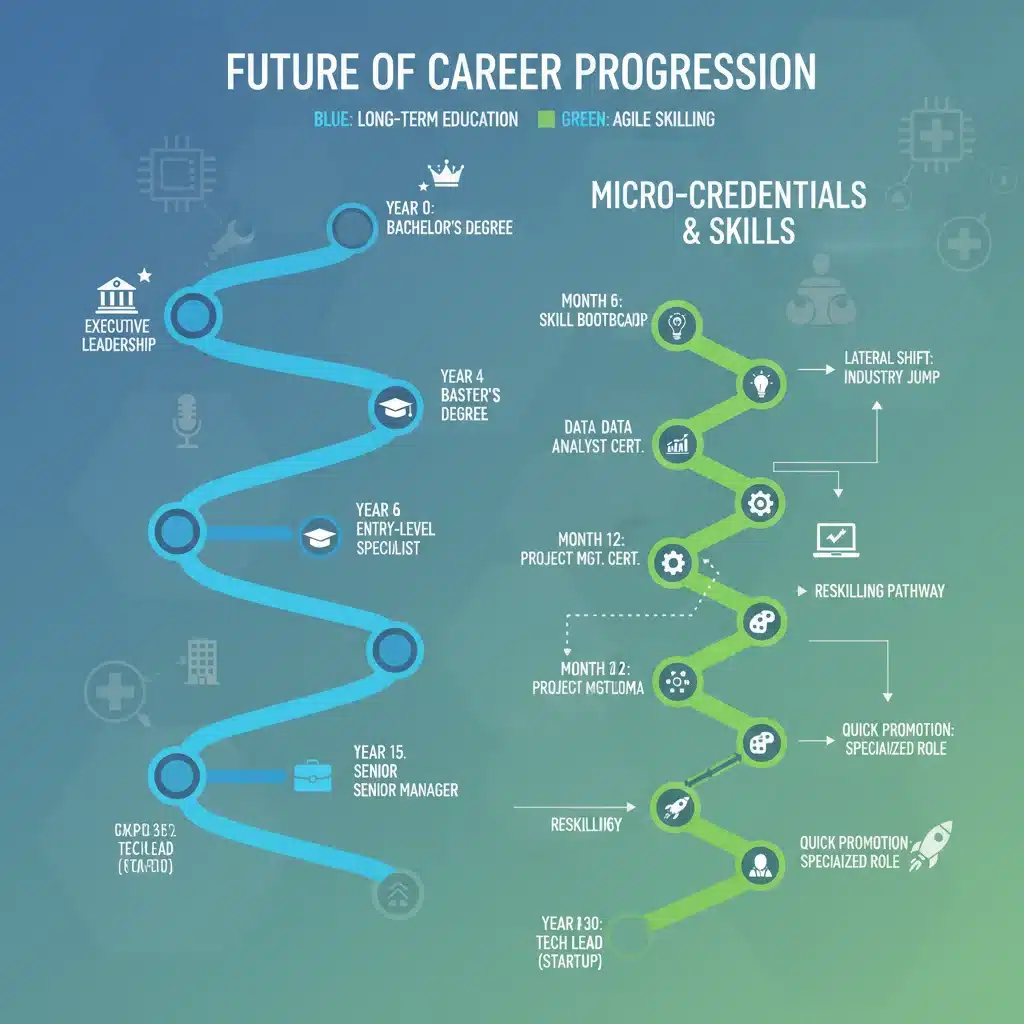
Looking ahead to 2026, the US job market is unlikely to be dominated by one form of credential over the other. Instead, we anticipate a hybrid landscape where both traditional degrees and micro-credentials play complementary roles, each serving distinct purposes and catering to different career stages and industry needs.
Complementary Pathways for Career Advancement
For many professionals, the optimal strategy will involve a combination of both. A traditional degree might provide the foundational knowledge and broad skills necessary for entry into a field, while micro-credentials can be used for continuous upskilling, specialization, or career pivots. For example, a business graduate might pursue micro-credentials in data analytics or digital marketing to enhance their marketability in specific roles. An engineer might acquire a certification in project management to move into a leadership position. This ‘stackable’ approach allows individuals to build a robust portfolio of skills and qualifications tailored to their career aspirations and the evolving demands of the micro-credentials job market.
Industry-Specific Demands
The weighting of traditional degrees versus micro-credentials will vary significantly by industry. In highly regulated fields like healthcare (e.g., doctors, nurses) or law, traditional degrees will likely remain paramount due to the extensive foundational knowledge and ethical training required. In contrast, fast-paced technological sectors (e.g., software development, cybersecurity, AI) are more amenable to micro-credentials, where rapidly acquired, specialized skills are highly prized. The creative industries, such as graphic design or content creation, might value a portfolio of work and relevant micro-credentials more than a traditional degree alone.
Employer Strategies and Talent Acquisition
Employers in 2026 will increasingly adopt a skills-based hiring approach, looking beyond just degree qualifications. They will seek verifiable competencies, whether acquired through a university program, a micro-credential, or on-the-job experience. This shift means that HR departments will need more sophisticated tools to assess and validate a diverse range of credentials. Companies may also invest more in internal micro-credentialing programs to train their existing workforce in new technologies or methodologies, fostering a culture of continuous learning and adaptability. The rise of the micro-credentials job market is pushing employers to rethink traditional hiring paradigms.
Navigating the Future: Advice for Professionals
For individuals planning their career trajectory in the 2026 US job market, a strategic approach to education and skill development is crucial.
Assess Your Career Goals
Before investing in any educational pathway, clearly define your career goals. Are you aiming for a highly specialized technical role, or do you aspire to leadership positions that require broader strategic thinking? Your goals will dictate whether a traditional degree, a micro-credential, or a combination of both is the most appropriate path. Research specific job descriptions and industry trends to understand the required qualifications.
Embrace Lifelong Learning
The concept of a static education followed by a lifelong career is obsolete. Professionals in 2026 must commit to lifelong learning. This means continuously seeking opportunities to update skills, learn new technologies, and adapt to changing industry demands. Micro-credentials are perfectly suited for this continuous learning model, allowing individuals to stay relevant and competitive throughout their careers. The dynamism of the micro-credentials job market necessitates this continuous engagement.
Build a Diverse Skill Portfolio
Instead of relying on a single credential, aim to build a diverse portfolio of skills. This might include a foundational degree complemented by several specialized micro-credentials, along with demonstrable project experience. A well-rounded skill set makes you more adaptable and resilient to economic shifts and technological disruptions. Showcasing both depth in a specific area (via micro-credentials) and breadth of understanding (via traditional degrees) will be a powerful combination.
Network and Seek Mentorship
Regardless of your chosen educational path, networking remains vital. Engage with professionals in your desired field, attend industry events (both virtual and in-person), and seek out mentors who can offer guidance and insights. These connections can provide valuable information about emerging trends, job opportunities, and the most reputable micro-credential providers. A strong professional network can often bridge gaps that formal credentials alone cannot.
The Role of Educational Institutions and Policy Makers
As the educational landscape evolves, traditional universities and colleges are not being left behind. Many institutions are adapting by offering their own micro-credentials, blending the academic rigor of a degree with the agility of specialized training. This hybrid model allows them to cater to a broader range of learners and remain relevant in a competitive market. Furthermore, policy makers have a crucial role in establishing quality standards for micro-credentials, promoting pathways for credit transfer, and ensuring that diverse educational achievements are recognized in hiring practices. A clear regulatory framework will enhance the credibility and value of the micro-credentials job market.
Conclusion
The 2026 US job market will be characterized by a dynamic interplay between traditional degrees and micro-credentials. While traditional degrees will continue to provide foundational knowledge, critical thinking, and broad career pathways, micro-credentials will offer unparalleled agility, targeted skill acquisition, and affordability for continuous professional development. The most successful individuals will likely be those who strategically leverage both, building a comprehensive and adaptable skill set that meets the evolving demands of employers. For organizations, understanding and integrating both credential types into their talent acquisition and development strategies will be key to staying competitive. The future of career advancement is not about choosing one over the other, but rather about intelligently combining them to forge a robust and resilient professional journey in a rapidly changing world. The growth of the micro-credentials job market signifies a permanent shift towards a more skills-focused economy, where continuous learning is not just an advantage, but a necessity.