For millions of Americans, the burden of student loan debt is a significant financial challenge that can impact everything from buying a home to planning for retirement. As we look ahead to 2026, understanding the landscape of student loan forgiveness programs becomes even more critical. The policies and programs surrounding student debt relief are constantly evolving, making it essential for borrowers to stay informed about eligibility criteria, application processes, and crucial deadlines. This comprehensive guide aims to demystify student loan forgiveness in 2026, providing a clear roadmap for those seeking to alleviate their financial strain.
Understanding the Current Landscape of Student Loan Forgiveness
The concept of student loan forgiveness isn’t new, but its implementation and accessibility have seen significant changes over the past few years. Various federal programs exist, each with its own set of rules and requirements designed to assist specific groups of borrowers. These programs are not a ‘one-size-fits-all’ solution, and what might work for one individual may not be applicable to another. Therefore, a thorough understanding of the different avenues available is the first step toward achieving debt relief.
The federal government typically offers several types of forgiveness, discharge, or cancellation programs. These can be broadly categorized based on the borrower’s profession, specific circumstances, or repayment history. Staying updated on legislative changes and administrative actions is vital, as these can significantly alter the availability and terms of existing or new programs. As we approach 2026, it’s anticipated that discussions around student debt will continue to be a prominent feature of national policy debates, potentially leading to further adjustments or expansions of relief efforts.
Key Federal Student Loan Forgiveness Programs for 2026
Several established federal programs are expected to continue offering student loan forgiveness in 2026. It’s crucial to differentiate between these and understand their specific requirements. Here are some of the most prominent ones:
Public Service Loan Forgiveness (PSLF)
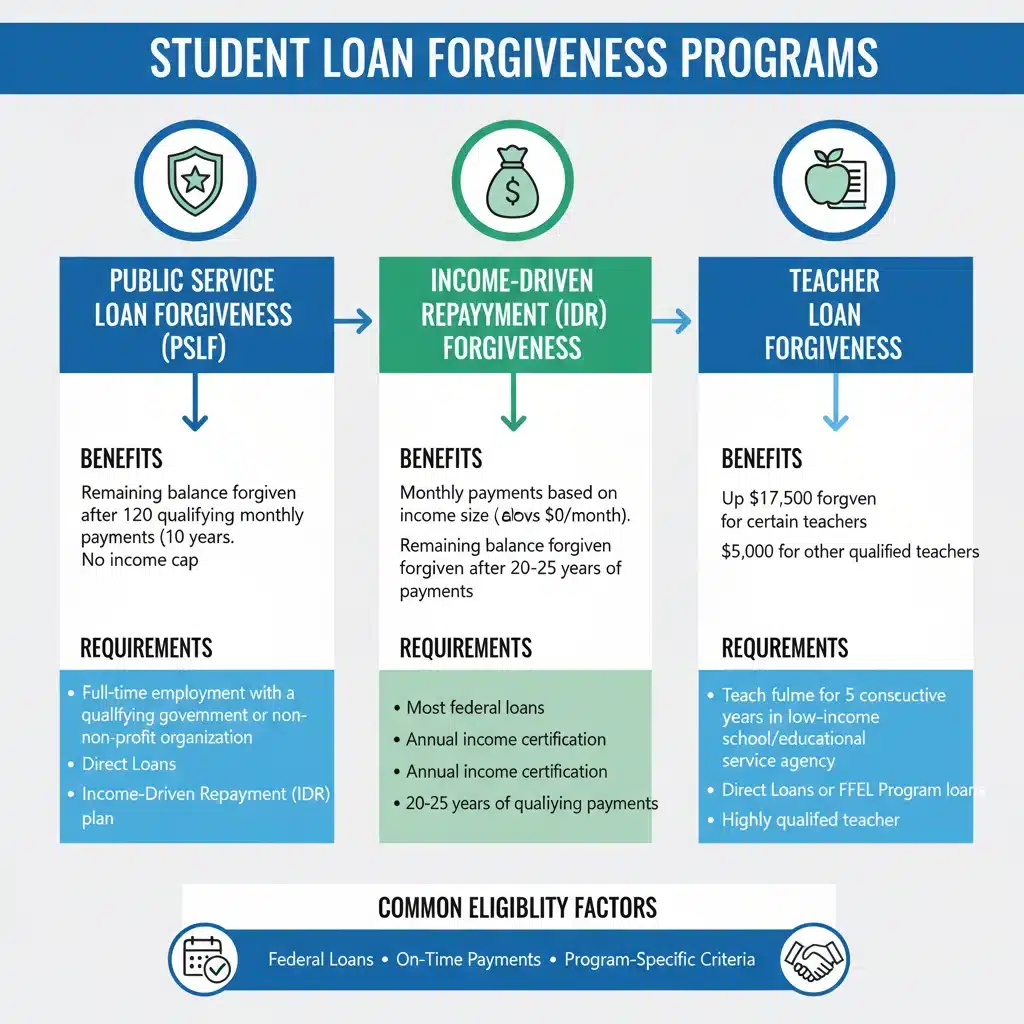
The Public Service Loan Forgiveness (PSLF) program is arguably one of the most well-known avenues for federal student loan relief. It is designed to encourage individuals to enter and remain in public service careers. Under PSLF, eligible federal student loans can be forgiven after 120 qualifying monthly payments while working full-time for a qualifying employer. Qualifying employers include government organizations (federal, state, local, or tribal), not-for-profit organizations that are tax-exempt under Section 501(c)(3) of the Internal Revenue Code, and other not-for-profit organizations that provide certain public services.
To qualify for PSLF, borrowers must have Direct Loans or consolidate other federal loans into a Direct Consolidation Loan. Payments must be made under an income-driven repayment (IDR) plan. The 120 payments do not need to be consecutive, allowing for periods of non-qualifying employment. However, borrowers must be employed full-time by a qualifying employer at the time they make each of the 120 payments and when they apply for forgiveness.
The PSLF program has undergone significant improvements and temporary waivers in recent years to address past administrative issues. While the Limited PSLF Waiver expired in October 2022, its impact may still be felt through increased awareness and streamlined processes. Borrowers should regularly check the Federal Student Aid website for the most current PSLF requirements and any new initiatives that may arise.
Income-Driven Repayment (IDR) Plan Forgiveness
Income-Driven Repayment (IDR) plans are designed to make student loan payments more manageable by capping them at a percentage of your discretionary income. There are several IDR plans, including Revised Pay As You Earn (REPAYE), Pay As You Earn (PAYE), Income-Based Repayment (IBR), and Income-Contingent Repayment (ICR). A key benefit of these plans is the provision for student loan forgiveness after a certain number of years of payments.
Under most IDR plans, any remaining loan balance is forgiven after 20 or 25 years of qualifying payments, depending on the plan and the type of loans. The specific duration can vary; for instance, undergraduate loans might be forgiven sooner than graduate loans under certain plans. This forgiveness is particularly beneficial for borrowers with high debt relative to their income, as it provides an eventual end point to their repayment obligations, even if they never pay off the full principal and interest.
It’s important to note that forgiven amounts under IDR plans might be considered taxable income by the IRS, though there have been temporary exemptions and discussions about permanent changes to this rule. Borrowers should consult with a tax professional to understand the potential tax implications of IDR forgiveness in 2026.
Teacher Loan Forgiveness (TLF)
The Teacher Loan Forgiveness (TLF) program provides relief to educators who teach full-time for five complete and consecutive academic years in certain low-income schools or educational service agencies. The amount of forgiveness depends on the subject taught. Highly qualified elementary and secondary education teachers can receive up to $5,000 in loan forgiveness. Highly qualified secondary school mathematics or science teachers, and highly qualified special education teachers, can receive up to $17,500.
To qualify, teachers must have Direct Subsidized or Unsubsidized Loans, or Federal Family Education Loan (FFEL) Program loans. The service must have been performed after the 1997-1998 academic year. It’s important to understand that borrowers cannot receive both PSLF and TLF for the same period of service. Teachers should evaluate which program offers them the most benefit.
Perkins Loan Cancellation
Federal Perkins Loans were a type of federal student loan that was offered to students with exceptional financial need. While the program ended in 2017, many borrowers still have outstanding Perkins Loans. These loans have their own specific cancellation provisions for individuals who work in certain public service professions. These professions include teaching in low-income schools, special education, early childhood education, law enforcement, nursing, and others.
The percentage of the loan that can be canceled increases with each year of qualifying service, potentially reaching 100% cancellation after five years. Borrowers with Perkins Loans should contact their loan servicer to inquire about cancellation eligibility, as the process is managed by the school that disbursed the loan or its assigned servicer.
Other Avenues for Student Loan Forgiveness or Discharge
Beyond the major programs, several other specific circumstances can lead to student loan forgiveness or discharge. These are typically less common but are vital for those who meet the criteria.
Total and Permanent Disability (TPD) Discharge
Borrowers who are determined to be totally and permanently disabled may be eligible for a Total and Permanent Disability (TPD) discharge of their federal student loans. This discharge can be granted based on documentation from the Department of Veterans Affairs (VA), the Social Security Administration (SSA), or a physician. If approved, all federal student loans are discharged, and the borrower is relieved of their obligation to repay them. There is typically a three-year monitoring period after discharge during which certain conditions must be met to ensure the discharge remains valid.
Borrower Defense to Repayment Discharge
This discharge is available to borrowers who can prove that their school misled them or engaged in other misconduct in violation of certain state laws. This could include misrepresentations about job placement rates, program accreditation, or the quality of instruction. The process for applying for Borrower Defense has evolved, and borrowers need to submit a detailed application with supporting evidence. This program has seen significant attention and changes in recent years, particularly concerning former students of certain for-profit institutions.
Closed School Discharge
If your school closes while you are enrolled or soon after you withdraw, and you do not complete your program at another school or through a teach-out agreement, you might be eligible for a Closed School Discharge. This discharge cancels 100% of the federal student loans you took out to attend that school. There are specific timelines and conditions for eligibility, so it’s important to act promptly if your school closes.
False Certification Discharge
A False Certification Discharge can be granted if your school falsely certified your eligibility to receive federal student loans. This can occur in a few scenarios, such as if the school falsely certified your ability to benefit from the education, if your identity was stolen and used to obtain loans, or if you were unable to meet state requirements for employment in your field of study due to a disqualifying status.
Eligibility Criteria for Student Loan Forgiveness in 2026
Understanding the general and specific eligibility criteria is paramount to successfully navigating the student loan forgiveness landscape. While each program has unique requirements, common threads run through many of them.
Type of Loans
Most federal student loan forgiveness programs apply exclusively to federal student loans. Private student loans are generally not eligible for federal forgiveness programs. If you have FFEL Program loans or Perkins Loans, you might need to consolidate them into a Direct Consolidation Loan to become eligible for programs like PSLF or certain IDR plans. It’s crucial to confirm whether your loans are federal or private and what specific type of federal loan you have.
Employment Requirements
For programs like PSLF and Teacher Loan Forgiveness, specific employment criteria must be met. This includes working full-time (generally 30 hours per week or more) for a qualifying employer. The definition of a ‘qualifying employer’ is strict for PSLF, encompassing government agencies and 501(c)(3) non-profits. Teachers need to work in designated low-income schools. Verifying your employment annually through the appropriate forms is often a requirement.
Repayment History and Plan
For IDR forgiveness and PSLF, your repayment history and the type of repayment plan you are on are critical. Payments made under standard repayment plans or other non-IDR plans generally do not count towards IDR forgiveness. For PSLF, all 120 qualifying payments must be made under an IDR plan. It is essential to be enrolled in the correct repayment plan from the outset or switch to one as soon as possible to ensure your payments count towards forgiveness.
Documentation and Verification
All student loan forgiveness programs require extensive documentation. This includes proof of employment, income verification, and records of your loan payments. Keeping meticulous records and submitting required forms, such as the PSLF Employment Certification Form, regularly can prevent delays and complications when you apply for forgiveness. Failing to provide accurate and timely documentation can lead to denial of your application.
Application Process and Key Deadlines for 2026
The application process for student loan forgiveness can be complex and time-consuming. It requires careful attention to detail and adherence to specific deadlines. While 2026 might seem far off, it’s never too early to start preparing.
Gathering Necessary Documents
Before you even begin the application, collect all relevant documents. This includes tax returns, pay stubs, W-2 forms, loan statements, and any employment verification letters. For PSLF, ensure your employer has correctly filled out the Employment Certification Form (ECF) for each period of qualifying employment. For IDR plans, you’ll need to recertify your income and family size annually.
Submitting Your Application
Each forgiveness program has its own application form. These forms are typically available on the Federal Student Aid website or through your loan servicer. Read the instructions carefully and fill out all sections accurately. Incomplete applications are a common reason for delays or denials.
Monitoring Your Progress
After submitting your application, it’s crucial to monitor its status. Your loan servicer or the Department of Education will communicate any requests for additional information or updates on your application. Be proactive in following up if you don’t hear back within the expected timeframe.
Important Deadlines and Timelines for 2026
While there isn’t a single universal deadline for all student loan forgiveness programs, certain aspects have ongoing or specific timelines:
- Annual IDR Recertification: Borrowers on IDR plans must recertify their income and family size annually. Failing to do so can lead to increased monthly payments and capitalization of interest.
- PSLF Employment Certification: While not strictly a deadline, it’s highly recommended to submit the PSLF Employment Certification Form annually or whenever you change employers. This helps track your qualifying payments and ensures accuracy.
- Specific Program Deadlines: Occasionally, new temporary forgiveness initiatives or waivers are introduced with specific application windows. Stay vigilant for announcements from the Department of Education or Federal Student Aid. For example, the IDR Account Adjustment is an ongoing initiative that could provide credit for past payments towards forgiveness, and borrowers should understand its implications for their loans.

Potential Changes and Future Outlook for Student Loan Forgiveness
The landscape of student loan forgiveness is not static. Policy debates, legislative actions, and administrative changes can significantly alter existing programs or introduce new ones. As we move towards 2026, it’s reasonable to expect continued discussion and potential reforms.
Legislative and Executive Actions
The federal government has shown an increased willingness to address student loan debt. Future legislative actions could expand eligibility for existing programs, introduce new broad-based forgiveness initiatives, or modify the tax treatment of forgiven debt. Executive actions, often through the Department of Education, can also lead to significant changes, such as the IDR Account Adjustment or targeted relief for specific groups of borrowers.
Economic Factors
Economic conditions can also influence the discussion around student loan debt. High inflation, potential recessions, or changes in employment rates could lead to renewed calls for broader debt relief or adjustments to repayment plans to help struggling borrowers. The impact of these factors on the availability and terms of student loan forgiveness in 2026 remains to be seen.
Importance of Staying Informed
Given the dynamic nature of student loan policy, the most crucial advice for borrowers is to stay informed. Regularly check official sources like the Federal Student Aid website (studentaid.gov), subscribe to updates, and consult with reputable financial advisors or student loan experts. Avoid scams and misinformation by relying only on official government channels for information.
Common Pitfalls to Avoid
Navigating student loan forgiveness can be tricky, and many borrowers make common mistakes that can jeopardize their eligibility or delay their relief. Being aware of these pitfalls can help you avoid them:
Not Understanding Your Loan Types
As mentioned, not all loans are eligible for all programs. Many borrowers mistakenly believe their private loans qualify for federal forgiveness, or they don’t realize their older federal loans need consolidation. Always verify your loan types.
Incorrect Repayment Plan Enrollment
A significant number of PSLF applicants have been denied in the past because they were not enrolled in a qualifying IDR plan for the entirety of their 120 payments. Ensure you are on the correct repayment plan from day one if you are pursuing an IDR-based forgiveness program.
Lack of Documentation
Failing to keep meticulous records of payments, employment history, and communications with your loan servicer can be a major setback. Treat your loan documents like important tax records.
Missing Deadlines
Whether it’s an annual IDR recertification or a specific application window for a temporary waiver, missing deadlines can have serious consequences, potentially resetting your progress toward forgiveness.
Falling for Scams
Unfortunately, the complexity of student loan forgiveness has led to an increase in scams. Be wary of companies that promise guaranteed forgiveness for a fee, ask for your FSA ID, or pressure you into quick decisions. The Department of Education and its servicers will never ask for payment to process forgiveness applications.
Strategies for Managing Student Loans While Awaiting Forgiveness
Even if you are on a path toward student loan forgiveness, effective management of your loans in the interim is essential. This ensures you remain eligible and minimize financial stress.
Budgeting and Financial Planning
Integrate your student loan payments into your overall budget. Even if payments are low under an IDR plan, consistent budgeting helps you manage other expenses and save for emergencies. Financial planning can also help you prepare for potential tax implications of forgiveness if applicable.
Understanding Interest Accrual
While interest may be subsidized on some loans under IDR plans, interest can still accrue, and balances can grow, especially if your payments are very low. Understanding how interest works on your specific loans helps you make informed decisions about your repayment strategy.
Exploring Other Debt Management Options
For borrowers with private student loans or those not qualifying for federal forgiveness, exploring other debt management options is crucial. This could include refinancing (if it makes financial sense and you don’t lose federal benefits), debt consolidation, or exploring employer-assisted repayment programs.
Regularly Reviewing Your Loan Details
Check your loan servicer’s website regularly. Verify your loan balances, repayment plan, and payment history. Report any discrepancies immediately. Proactive monitoring can catch errors that might impact your forgiveness journey.
Conclusion
The prospect of student loan forgiveness offers a beacon of hope for many borrowers grappling with substantial educational debt. As we approach 2026, the various federal programs—including PSLF, IDR forgiveness, and Teacher Loan Forgiveness—continue to provide pathways to relief, albeit with specific and often stringent requirements. Understanding your loan types, meticulously tracking your employment and payments, and adhering to all application procedures and deadlines are non-negotiable steps toward achieving debt relief.
The policy landscape for student loans is dynamic, necessitating continuous vigilance and reliance on official sources for accurate information. By staying informed, preparing diligently, and avoiding common pitfalls, borrowers can significantly improve their chances of successfully navigating the complex world of student loan forgiveness and ultimately achieve greater financial freedom. Take the time now to assess your situation, understand your options, and strategically plan your path to a debt-free future.